
Search Massachusetts Bankruptcy Records
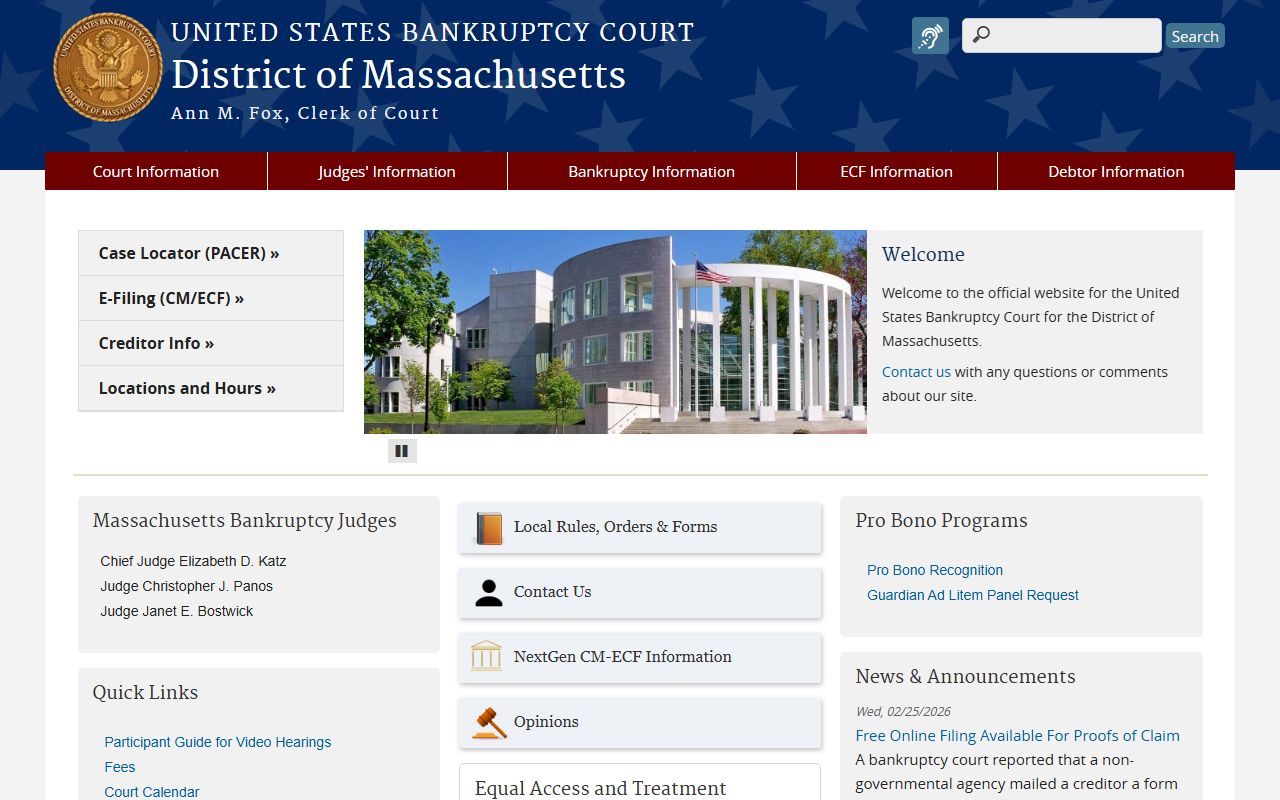
Massachusetts bankruptcy records are public documents held by the U.S. Bankruptcy Court for the District of Massachusetts. The court handles all Chapter 7, Chapter 13, and Chapter 11 cases filed by residents and businesses across the state. You can search these bankruptcy records online through PACER, by phone through the free VCIS system, or in person at one of three courthouse locations in Boston, Worcester, and Springfield. This guide covers how to find, access, and request copies of Massachusetts bankruptcy records.
Massachusetts Bankruptcy Records at a Glance
Where to Find Massachusetts Bankruptcy Records
Bankruptcy is federal law. All cases in Massachusetts go through the U.S. Bankruptcy Court for the District of Massachusetts. The court runs three divisions: Eastern in Boston, Central in Worcester, and Western in Springfield. Which division holds a person's records depends on where they lived when they filed. Most of the state files in Boston. Worcester handles central communities and parts of Middlesex and Essex counties. Springfield covers the four western counties: Berkshire, Franklin, Hampden, and Hampshire.
The Eastern Division courthouse sits at 5 Post Office Square, Suite 1150, Boston, MA 02109. It serves Suffolk, Norfolk, Bristol, Plymouth, Barnstable, Dukes, Nantucket, and portions of Middlesex and Essex counties. Call (617) 748-5300 with questions. After-hours emergency filings go through (617) 748-5317. The Central Division is at 595 Main Street, Room 311, Worcester, MA 01608. Reach them at (508) 770-8900. Note that 341 creditor meetings in Worcester are held at 441 Main Street, not at the courthouse. The Western Division is at 300 State Street, Springfield, MA 01105. Their number is (413) 785-6900, with an after-hours beeper at (800) 759-8888, PIN 1309280.
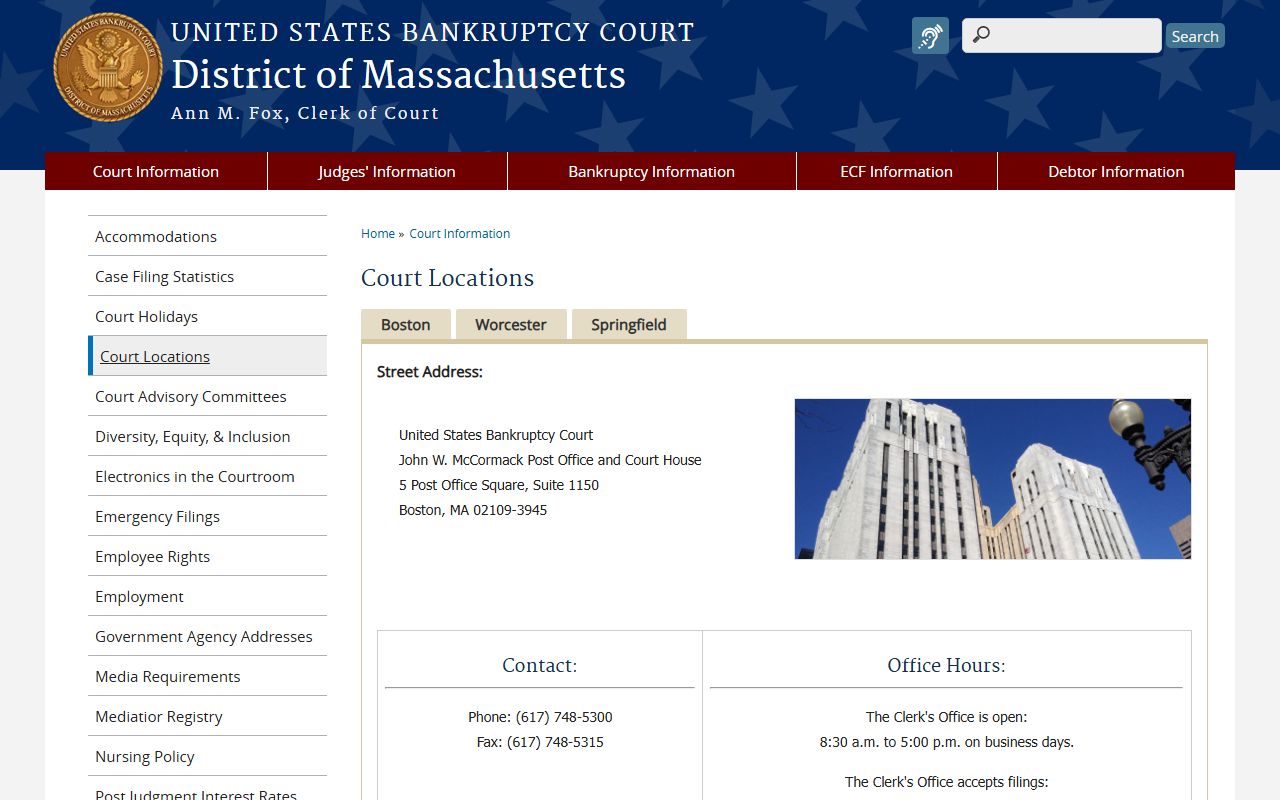
The court locations page at mab.uscourts.gov lists addresses, phone numbers, and hours for all three offices. All three are open Monday through Friday. Boston and Worcester run 8:30 a.m. to 5:00 p.m., with filings accepted until 4:30 p.m. Springfield closes at 4:30 p.m.
How to Search Bankruptcy Records in Massachusetts
PACER is the primary tool for searching Massachusetts bankruptcy records online. It stands for Public Access to Court Electronic Records. Register for a free account at pacer.uscourts.gov. Once in, you can search by debtor name, case number, or Social Security number. PACER charges $0.10 per page with a cap of $3.00 per document. If your total charges in a quarter stay under $30, no bill is sent. Around 75% of PACER users pay nothing each quarter. The system is available around the clock.
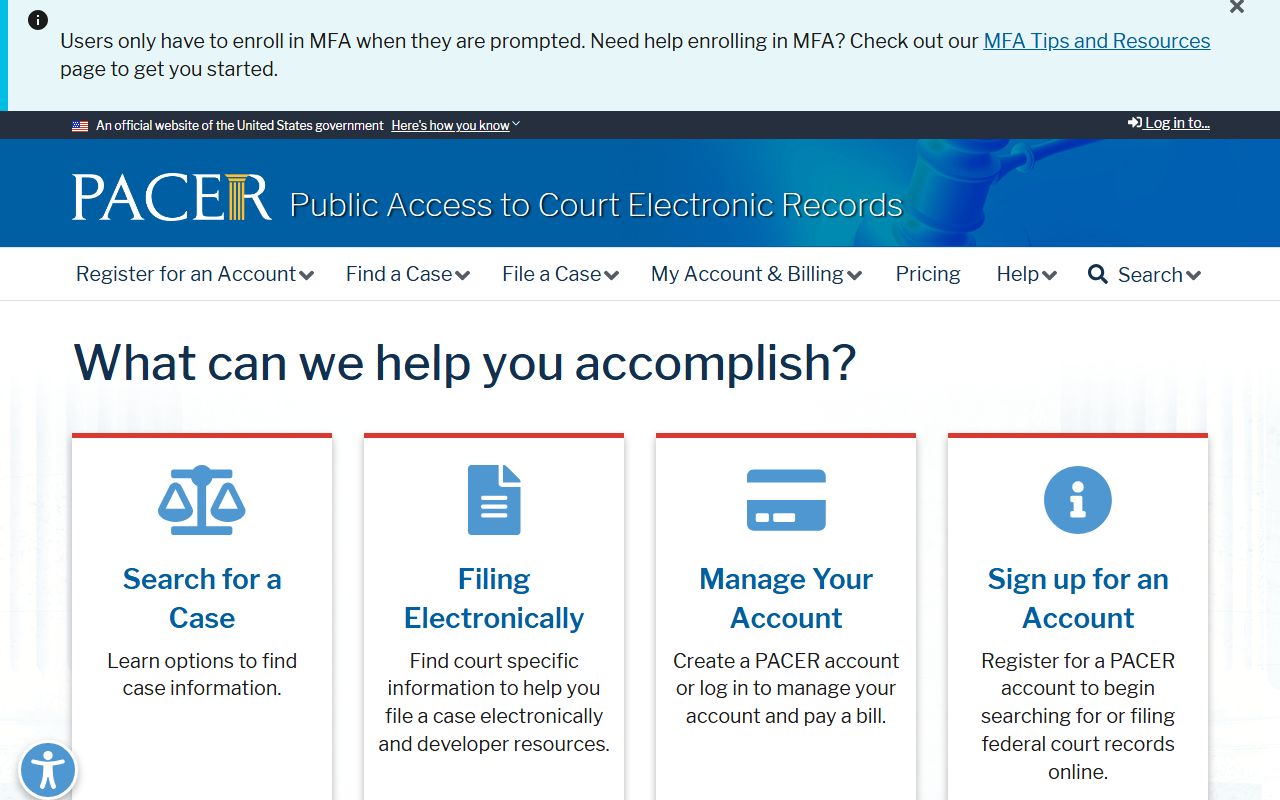
The PACER Case Locator lets you search across every federal court at once. This helps when you aren't sure which state a case was filed in. For cases limited to Massachusetts, go straight to the District of Massachusetts within PACER. You can view dockets, filed documents, creditor lists, and discharge orders. Documents are available in PDF format.
The Voice Case Information System (VCIS) is a free phone option. Call 1-866-222-8029 and press 1 for Massachusetts. It runs 24 hours a day, every day. Search by name, case number, Social Security number, or tax ID. VCIS returns the debtor name, case number, filing date, chapter, trustee, judge, 341 meeting date, discharge date, and case status. There's no cost to use it. The system may be down for maintenance on Mondays from 7:30 to 8:30 a.m.
Public terminals are set up at all three clerk's offices. You can view records there at no charge. Printing costs $0.10 per page at the terminal. To request certified copies, the court charges $12.00 per document plus copy fees. See the court's document access guide for the full process.
Types of Massachusetts Bankruptcy Records
Chapter 7 is the most common type of Massachusetts bankruptcy filing. It is a liquidation case. A trustee reviews the debtor's assets, sells what isn't protected by exemptions, and pays creditors. Remaining qualifying debts get discharged. Under 11 U.S.C. § 727, a Chapter 7 discharge wipes out most unsecured debts. The filing fee is $338. About 63% of Massachusetts filings in 2024 were Chapter 7 cases. Fee waivers are available on Form 103B for those with income below 150% of the federal poverty guideline.
Chapter 13 is for people with regular income who want to keep property while paying back debts. You file a 3 to 5 year repayment plan. The court and trustee review the plan, and creditors can object. Chapter 13 records include the proposed plan, creditor claims, trustee reports, and the confirmation order. The filing fee is $313. About 34% of Massachusetts filings in 2024 were Chapter 13. This type is popular in high-value areas because it lets debtors catch up on mortgage payments and keep the home. Under 11 U.S.C. § 1325, the plan must be proposed in good faith and meet certain payment tests before a judge confirms it.
Chapter 11 is for businesses and individuals with complex debt situations. The filing fee is $1,738. It involves a reorganization plan approved by creditors and the court. Chapter 12 serves family farmers and fishermen. Chapter 15 handles cross-border cases involving foreign companies. All these case types create public records available through PACER or at the clerk's office. The court's FAQ page breaks down each chapter in plain terms.
Massachusetts Bankruptcy Exemptions
Massachusetts debtors can choose between federal exemptions and state exemptions when they file. You pick one set or the other. The Massachusetts homestead exemption under Mass. Gen. Laws c. 188 is one of the strongest in the country. Without a filed declaration of homestead, you protect up to $125,000 of home equity. With a declaration on file at the Registry of Deeds, that number rises to $500,000. Elderly and disabled homeowners may qualify for the higher amount even without a declaration. You must have owned and lived in the property for at least 1,215 days before filing.
Other state exemptions include up to $7,500 in vehicle equity, rising to $15,000 for the disabled or those over 60. Clothing and furniture are protected up to $15,000 each. Tools of your trade are exempt up to $5,000. Under 11 U.S.C. § 522, the federal wildcard lets you protect an additional $1,325 plus any unused homestead amount, up to $12,575. IRAs are protected up to $1,362,800 under federal rules. Retirement benefits from public employment are fully exempt under Massachusetts law.
Under 11 U.S.C. § 523, some debts cannot be erased no matter what chapter you file. These include most student loans, recent taxes, child support, alimony, and debts from fraud. The automatic stay under 11 U.S.C. § 362 takes effect the moment you file. It stops creditor calls, wage garnishment, foreclosure actions, and most lawsuits against you. The stay remains active while your case is open.
Bankruptcy Record Fees in Massachusetts
What you pay to access Massachusetts bankruptcy records depends on how you search. PACER charges $0.10 per page with a $3.00 cap per document. Free viewing is available at clerk's office terminals, though printing still costs $0.10 per page. Mail requests cost $34.00 per document search plus copy fees ($0.50 per photocopied page, $0.10 per electronically printed page). Certified copies add a $12.00 fee per document. Audio recordings of hearings, available on CD or USB drive, cost $34.00 each.
Filing fees are separate. Chapter 7 costs $338. Chapter 13 costs $313. Chapter 11 costs $1,738. Chapter 12 costs $278. Adversary proceedings cost $350. Converting a case from Chapter 13 to Chapter 7 costs $25. Reopening a case costs $260. For up-to-date fee information, see the court's local rules page. Payment for mail requests must be a cashier's check or money order. Make it payable to "Clerk, United States Bankruptcy Court." Personal checks are not accepted.
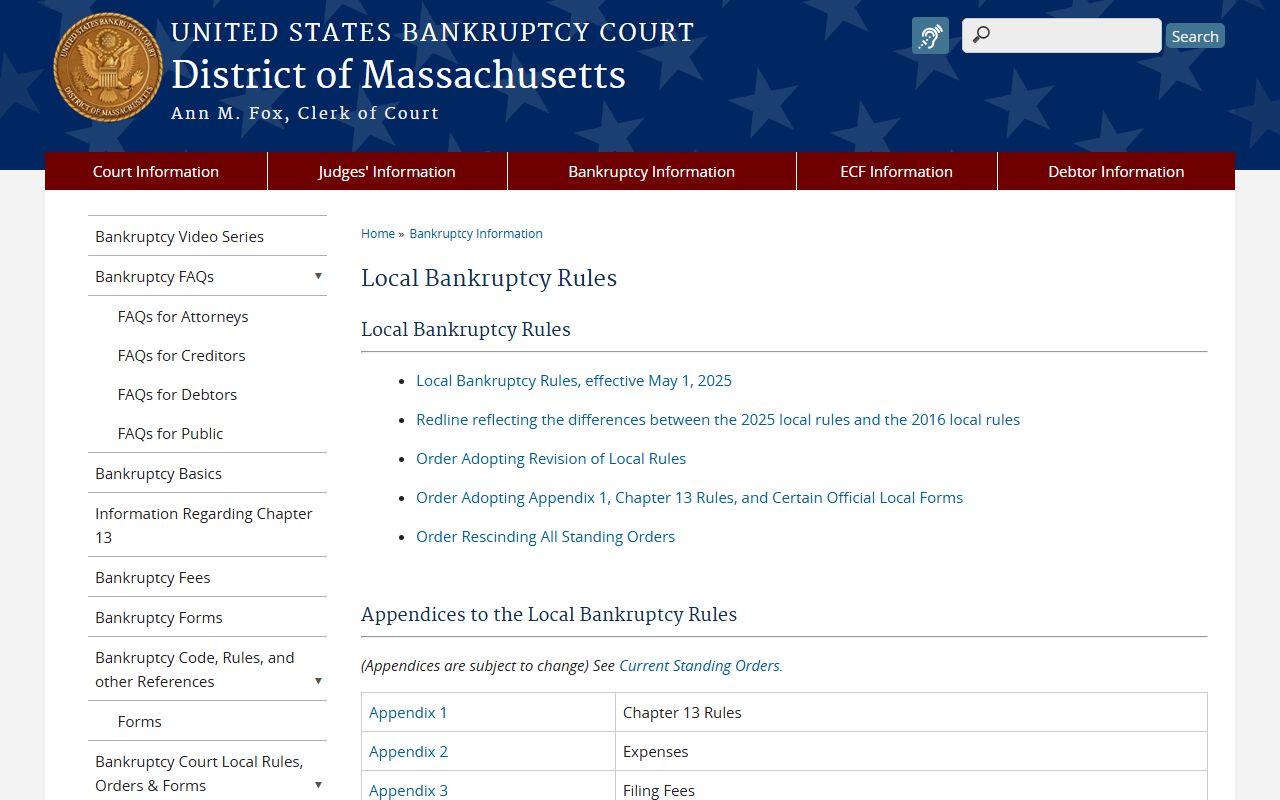
Note: Installment payment plans for filing fees are available on Form 103A. Fee waivers for Chapter 7 filers with income below 150% of federal poverty guidelines are available on Form 103B.
How to Get Copies of Bankruptcy Records
There are three ways to get copies of Massachusetts bankruptcy records. Online through PACER is the fastest. Log in at pacer.uscourts.gov, find the case, and download what you need. Documents come as PDFs. Review the case file review page for rules on what you can access and how to handle physical files.
In person at a clerk's office is your second option. Bring the case name or number. Staff can locate the file and provide copies. You pay per page. Certified copies require an additional $12.00 fee each. Clerks can search by debtor name using the PACER terminal at the public counter if you don't have the case number. Files must stay in the office at all times. Removing files is a federal offense under 18 U.S.C. § 2071. You can return files in proper order when done reviewing them.
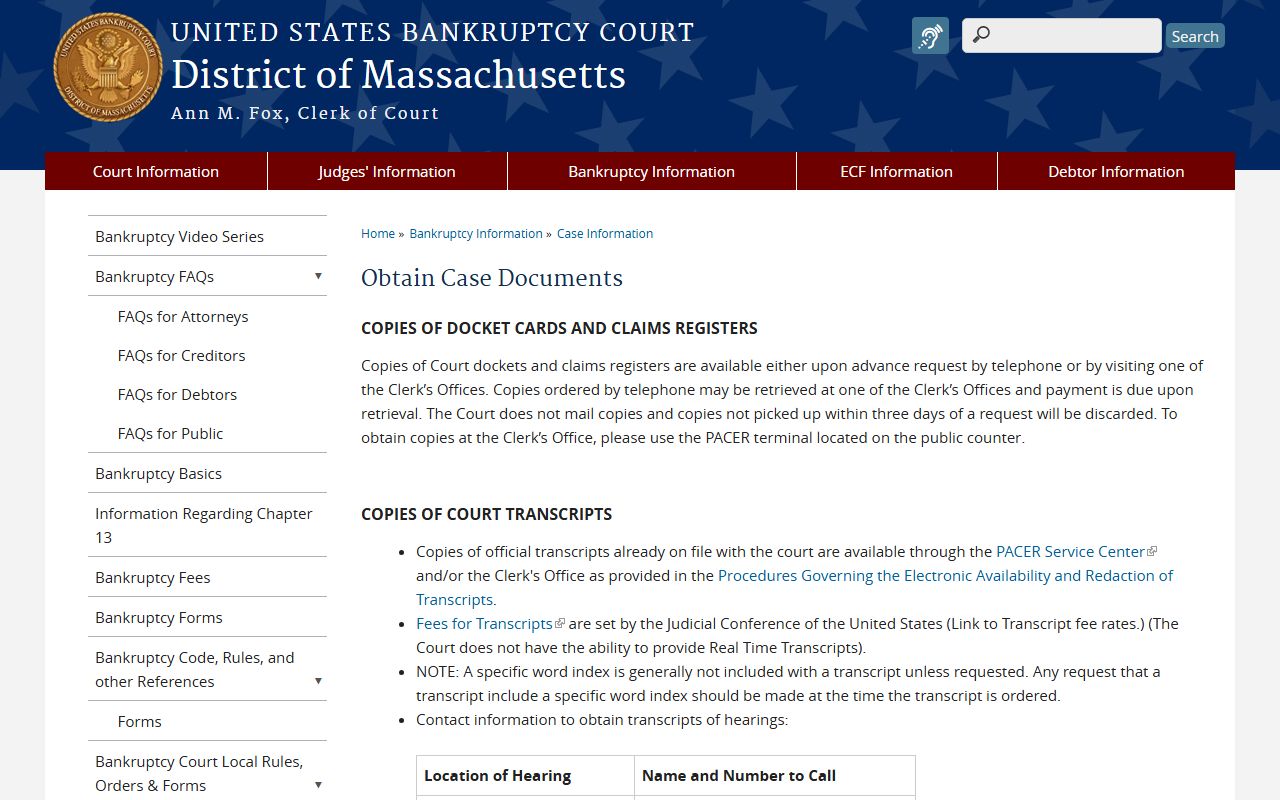
The third option is mail. Write to the clerk's office where the case was filed. Include the case name, case number, document title, filing date, and your contact information. Enclose a cashier's check or money order. The court doesn't mail copies unless you provide a self-addressed stamped envelope. Copies left uncollected after 3 days get discarded. Transcript fees vary by how quickly you need them. Within 30 days, the original costs $3.65 per page. Expedited rates go up from there.
Old or closed cases may be at the National Archives. The Federal Records Center for Massachusetts is at 380 Trapelo Road, Waltham, MA 02452. Use NATF Form 90 to request records there. Fees include $10 per order plus $9.90 retrieval and $0.65 per page.
Legal Help for Bankruptcy in Massachusetts
Greater Boston Legal Services offers free civil legal help including bankruptcy for qualifying residents. They are at 197 Friend Street, Boston, MA 02114. Call (617) 371-1234 or 1-800-323-3205. Community Legal Aid covers central and western Massachusetts including Worcester, Franklin, Hampden, Hampshire, and Berkshire counties. Call (855) 252-5342. The Volunteer Lawyers Project provides pro bono bankruptcy help. Reach them at (617) 603-1700. Their website covers how to apply and what cases they take.
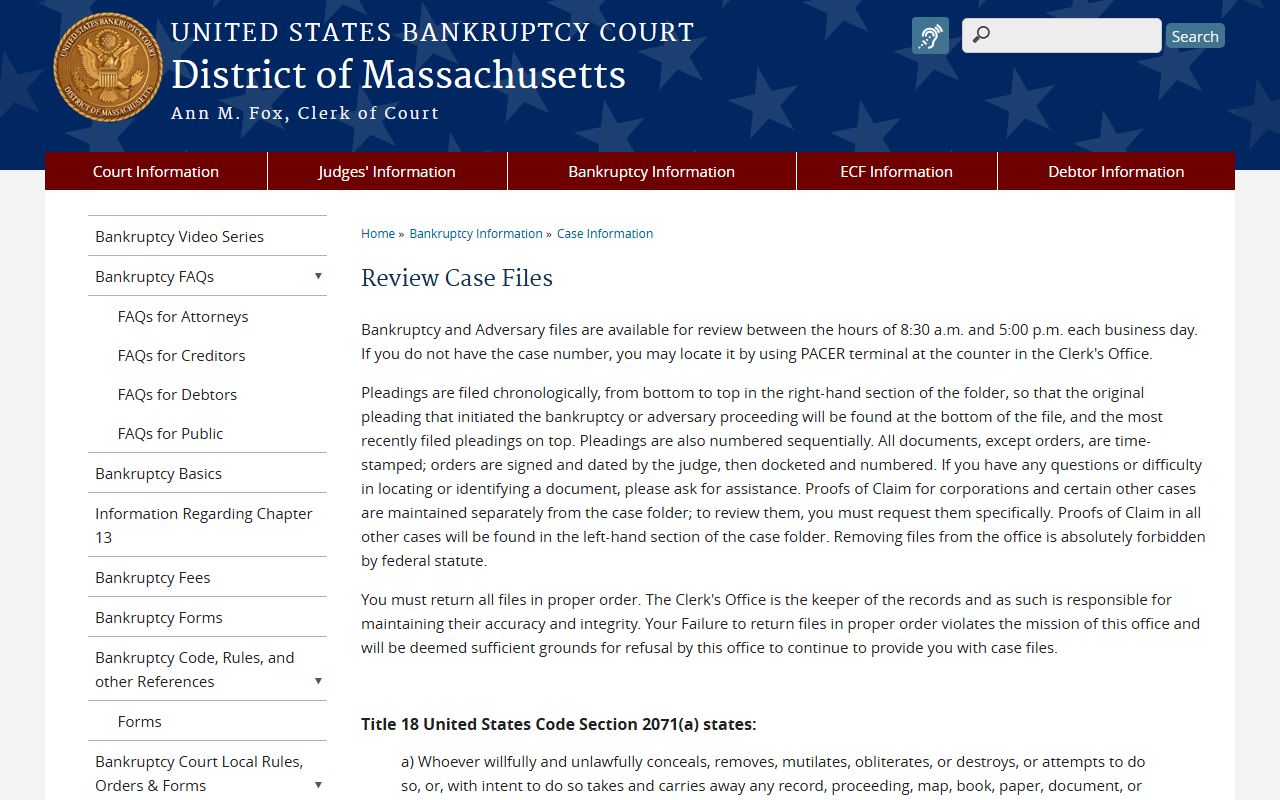
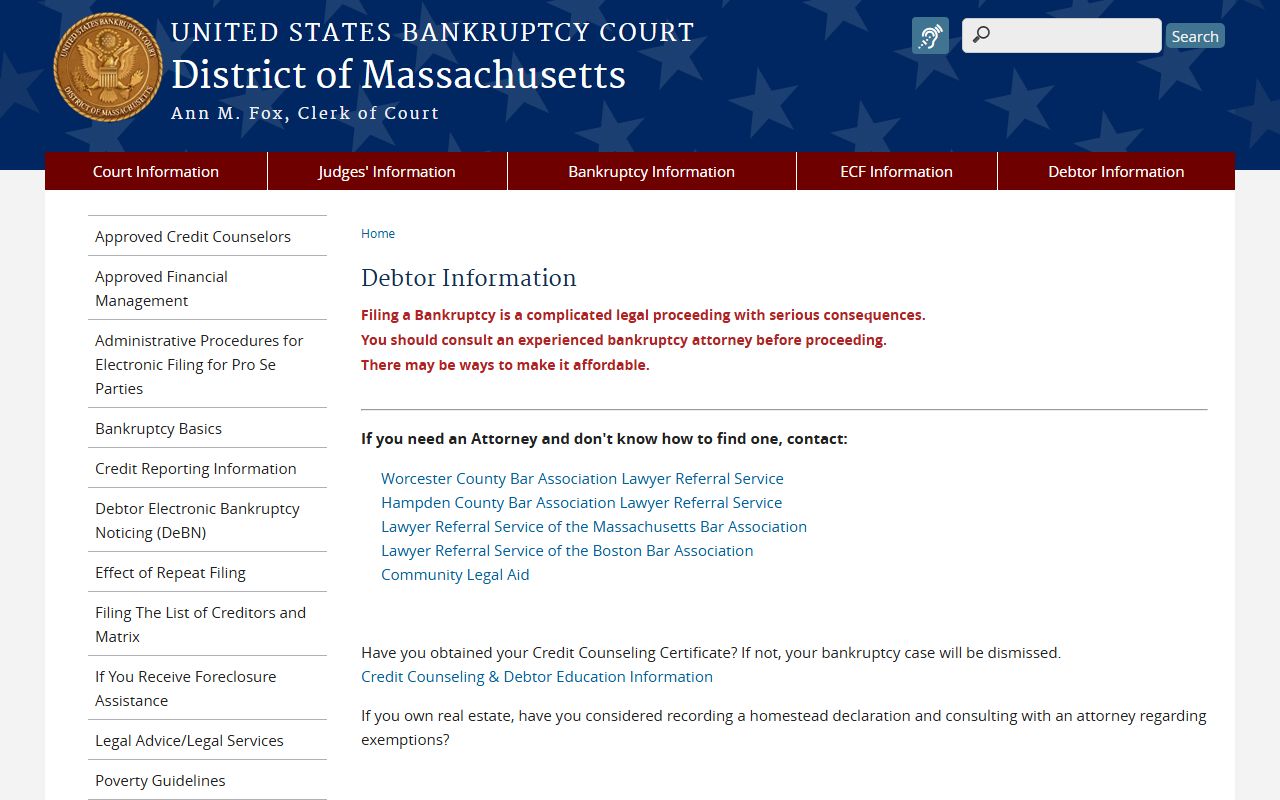
The Massachusetts Bar Association has a referral service. Call (617) 654-0400 or (866) 627-7577. They connect you with attorneys in your area who handle bankruptcy cases. The state's official bankruptcy law page covers key rules in plain language. The court also has a debtor information page with forms and guides for people filing without a lawyer. As of May 1, 2025, pro se debtors can file by emailing PDF documents to prose_filings@mab.uscourts.gov.
Are Massachusetts Bankruptcy Records Public
Yes. Bankruptcy records are public under federal law. Anyone can search and view case records through PACER, call the free VCIS line, or visit a clerk's office in person. You don't need to be a party to the case. No reason is required. These are federal court records, and access is open to everyone.
Some personal information is redacted from public records. Full Social Security numbers are not shown. Financial account numbers are removed. Names of minor children are protected. In rare cases, a party can ask the court to seal records. A judge holds a hearing and decides. Most bankruptcy records stay fully open. Statewide filing statistics confirm that Massachusetts saw 4,704 bankruptcy cases filed in 2024, a 21.6% jump from 2023 as pandemic-era protections ended.
Credit agencies also track bankruptcy filings. Chapter 7 stays on a credit report for 10 years from the filing date. Chapter 13 stays for 7 years. But the court records themselves remain permanently accessible through PACER and do not expire.
Browse Massachusetts Bankruptcy Records by County
Each county in Massachusetts is served by one of the three federal bankruptcy court divisions. Pick a county below to find the right court and local resources.
View All 14 Massachusetts Counties
Bankruptcy Records in Major Massachusetts Cities
Residents of major cities file for bankruptcy at the federal court division covering their area. Pick a city below to find local courthouse information and legal resources.