
Search Middlesex County Bankruptcy Records
Middlesex County bankruptcy records are filed with the U.S. Bankruptcy Court for the District of Massachusetts and are available to the public through PACER and in-person requests. This is Massachusetts's most populous county, with about 1.6 million residents spread across dozens of cities and towns. Depending on where you live in Middlesex County, your case may be filed in Boston or Worcester, as the county spans two federal court divisions. This guide explains how to find bankruptcy records, what each division covers, and where to get help in Middlesex County.
Middlesex County Overview
Which Court Division Handles Middlesex County?
Middlesex County is split between two divisions of the U.S. Bankruptcy Court for the District of Massachusetts. Your town determines where you file. This is the first thing to check before you search for Middlesex County bankruptcy records, because the two divisions maintain separate dockets and case numbering systems.
The Eastern Division in Boston handles filings from Arlington, Belmont, Burlington, Cambridge, Everett, Lexington, Lincoln, Malden, Medford, Melrose, Natick, Newton, North Reading, Reading, Sherborn, Somerville, Stoneham, Wakefield, Waltham, Watertown, Wayland, Weston, Wilmington, Winchester, and Woburn. The Boston courthouse is at 5 Post Office Square, Suite 1150, Boston, MA 02109. You can reach them at (617) 748-5300. If you need Middlesex County bankruptcy records for any of these communities, you start your search at the Eastern Division.
The Central Division in Worcester serves Lowell (the county seat), Framingham, Marlborough, and most other Middlesex County towns not listed above. That office is at 595 Main Street, Room 311, Worcester, MA 01608, phone (508) 770-8900. Filings are on the Worcester docket. Both offices follow the same federal rules and charge the same fees. The court locations page at the official U.S. Bankruptcy Court website shows a full breakdown of which communities go to which division.
The split can be confusing. Lowell, the county seat, files in Worcester. Cambridge, which is far from Boston geographically relative to other Eastern Division towns, files in Boston. When in doubt, call the court before you drive to the courthouse. Staff can confirm which division handles your town in about one minute.
How to Access Middlesex County Bankruptcy Records
The primary way to search Middlesex County bankruptcy records online is through PACER (Public Access to Court Electronic Records) at pacer.uscourts.gov. PACER lets you search by name, case number, Social Security number, or tax ID. You can view dockets, download documents, and check case status for any Middlesex County bankruptcy filing from the past several decades. Most records from the 1990s onward are fully digitized.
PACER charges $0.10 per page, with a cap of $3.00 per document. Accounts that accrue less than $30.00 in fees per quarter pay nothing. You register for a free account at pacer.gov. Once logged in, select the "District of Massachusetts" court. You can search either the Eastern or Central Division from a single account. For older Middlesex County bankruptcy records that predate electronic filing, some case files exist only on paper or microfilm at the court or the NARA Federal Records Center at 380 Trapelo Road in Waltham, MA 02452.
If you don't want to create a PACER account, you can call the free Voice Case Information System (VCIS) at 1-866-222-8029. Press 1 for Massachusetts. VCIS gives basic case status, trustee info, and hearing dates. It does not provide documents. This line runs 24 hours a day, seven days a week, and it costs nothing to use. It's a fast way to check whether a Middlesex County bankruptcy case is open, closed, or discharged before you dig deeper.
For in-person access, visit either courthouse during business hours. You can use the public terminals there to view Middlesex County bankruptcy records at no charge. Staff can help you pull paper files for older cases. Certified copies cost $12.00, plain photocopies run $0.50 per page, and a court search fee is $34.00. The document access page on the court's site walks through each method in detail.
The court's official site at mab.uscourts.gov also has a page for reviewing case files that explains the steps for both PACER and in-person requests. Check there first if you have questions about what's available for a specific Middlesex County case.
The court captures a screenshot of its locations page, which shows where Middlesex County residents file based on their town. The court locations page lists every community by division.
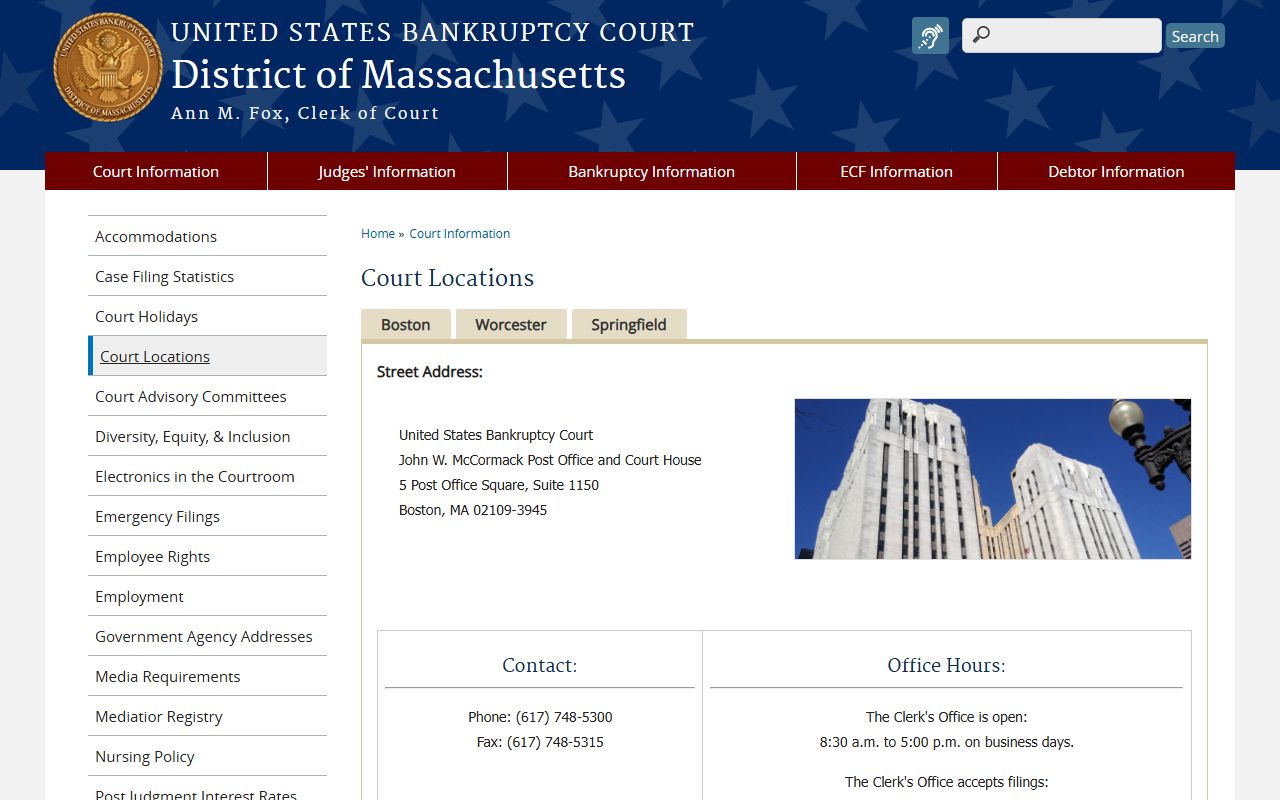
This page is the fastest way to confirm which division serves your Middlesex County address.
Filing Fees for Middlesex County Bankruptcy Cases
Federal filing fees are the same across all of Massachusetts, including Middlesex County. The fee depends on which chapter you file under. Chapter 7, which eliminates most unsecured debt, costs $338 to file. Chapter 13, which sets up a repayment plan, costs $313. Chapter 11, used by businesses and some individuals with high debt, costs $1,738. These fees are set by federal law and apply equally whether you file in Boston or Worcester for your Middlesex County case.
You can pay by money order, cashier's check, or cash at the courthouse. Personal checks are not accepted. If you cannot afford the filing fee for a Chapter 7 case, you may apply to pay in installments or request a fee waiver. The debtor FAQ page explains eligibility for fee waivers. Fee waivers are only available for Chapter 7 and require your income to be below 150% of the federal poverty level. Most Chapter 13 filers in Middlesex County pay the full $313 at filing.
Record copy fees also apply when you want documents from a closed Middlesex County bankruptcy case. Certified copies run $12.00 each. Plain photocopies cost $0.50 per page. Court searches cost $34.00. PACER is usually cheaper for most requests.
What Middlesex County Bankruptcy Records Include
A Middlesex County bankruptcy file typically contains the petition, all schedules of assets and liabilities, the statement of financial affairs, and any motions filed during the case. The petition itself names the debtor, lists the chapter filed, and shows the case number. Schedules break down property, debts, income, and expenses in detail. These documents are public unless the court has sealed them, which is rare in consumer cases.
The automatic stay, governed by 11 U.S.C. § 362, takes effect the moment a Middlesex County debtor files. It stops most collection actions. Records of creditor claims, trustee reports, and any court orders all appear in the PACER docket. If a creditor objects to discharge under 11 U.S.C. § 523, those filings are also in the public record. For Chapter 7 cases, the discharge order under 11 U.S.C. § 727 appears at the end of the case and is one of the most commonly requested documents.
Chapter 13 records in Middlesex County include the repayment plan, any amendments to it, and trustee payment histories. These cases can run three to five years, so the docket can be long. Chapter 11 cases, which are more common in Middlesex County than in most Massachusetts counties due to the tech and biotech sector, may include hundreds of docket entries. Business reorganization plans and creditor committee filings are all public records.
Exemptions matter a lot in Middlesex County, where home values routinely exceed $600,000. Massachusetts allows a homestead exemption of $500,000 for a declared homestead or $125,000 for an automatic one under 11 U.S.C. § 522, which governs exemptions in federal bankruptcy. Schedules showing how a debtor claims these exemptions are part of the public record for any Middlesex County bankruptcy filing.
The Middlesex County court records database gives another angle on related state court proceedings that may run alongside a federal bankruptcy.
Middlesex County Court Records covers state-level proceedings that may intersect with a federal bankruptcy case.
Checking both the federal PACER system and the state court database gives the most complete picture of any debtor's legal history in Middlesex County.
Middlesex County Registry of Deeds and Bankruptcy
The Middlesex County Registry of Deeds keeps real property records that often connect to bankruptcy cases. When someone in Middlesex County files for bankruptcy, their home and any other real estate become part of the bankruptcy estate. Deeds, mortgages, liens, and discharges are all recorded with the Registry and can help you understand a debtor's property situation. Middlesex County actually has two Registry offices. The South Registry is at 208 Cambridge Street, Cambridge, MA 02141, phone (617) 494-4500. The North Registry is at 360 Gorham Street, Lowell, MA 01852, phone (978) 322-8000.
The Registry's online search tool at middlesexdeeds.com is free to use. You can search by name or property address. If a bankruptcy discharge wiped out a mortgage lien, there should be a corresponding release recorded at the Registry. If you're trying to trace what happened to a Middlesex County property after a bankruptcy, the deeds records are the place to check.
The Registry was among the first in Massachusetts to computerize its index, which means electronic records go back further than in most other counties. The combination of the PACER docket and the Registry of Deeds database gives researchers and attorneys a thorough look at any Middlesex County bankruptcy involving real property.
The Registry of Deeds website lets you search property records connected to Middlesex County bankruptcy cases.

Lien releases and property transfers recorded after a Middlesex County bankruptcy discharge appear in the Registry's public database.
Middlesex County Bankruptcy Filing Trends
Massachusetts saw 4,704 total bankruptcy filings in 2024, a 21.6% increase from 2023. Middlesex County accounts for an estimated 25 to 30 percent of statewide filings, making it the highest-volume county in the district. This reflects both the county's large population and its economic complexity. The Route 128 tech corridor runs through several Middlesex County communities, and business cycles in that sector drive Chapter 11 activity. Small business Chapter 11 filings have become more common since the Subchapter V small business provisions took effect.
Chapter 7 cases make up about 63% of all Massachusetts filings. Chapter 13 accounts for roughly 34%. In Middlesex County, the Chapter 13 rate tends to run higher than the state average. This is partly because more residents own homes and want to keep them. Chapter 13 lets filers catch up on mortgage arrears over three to five years. Given that median home values in Middlesex County exceed $600,000 in many communities, protecting that equity is a major motivation for choosing Chapter 13 over Chapter 7.
Chapter 11 business cases in Middlesex County often involve more complex records. These dockets can include hundreds of filings: motions, creditor committee reports, asset sale orders, and reorganization plans. Researching a Middlesex County Chapter 11 on PACER takes more time than a simple consumer case. The local rules page explains filing requirements that affect what documents appear in the docket.
Pro Se Filers in Middlesex County
Some Middlesex County residents file for bankruptcy without a lawyer. This is called filing pro se. The court allows it. As of May 1, 2025, the court accepts pro se filings by email at prose_filings@mab.uscourts.gov. This makes it easier for Middlesex County residents who can't get to a courthouse to submit their documents. Check the debtor information page for the full set of instructions and required forms.
The court also has a helpful FAQ for debtors that covers common questions about the process, what to bring to the 341 meeting, and how long cases take. The state's own overview at mass.gov covers the basics of Massachusetts bankruptcy law in plain language. Neither source provides legal advice, but both are useful starting points for anyone considering filing in Middlesex County.
Legal Aid for Middlesex County Bankruptcy
Several nonprofit organizations provide free or low-cost legal help to Middlesex County residents facing bankruptcy. Income limits apply, but many people qualify. Getting even a brief consultation before you file can help you avoid mistakes that are hard to fix later.
The Harvard Legal Aid Bureau at 23 Everett Street, Cambridge, MA 02138, phone (617) 495-4408, offers free civil legal help to low-income Massachusetts residents. Their work covers a range of consumer law issues. Visit harvardlegalaid.org to learn more about eligibility and services for Middlesex County residents. Boston College Legal Services LAB at 855 Center Street, 3rd Floor, Newton, MA 02459, phone (617) 552-2459, is another resource. Their site at bclawlab.org has intake information for Middlesex County applicants.
MetroWest Legal Services, reachable at (508) 620-1830, serves Framingham and the western Middlesex County communities that fall under the Worcester Division. Northeast Legal Aid at (978) 458-1465 handles northern Middlesex County towns like Lowell, where residents file at the Worcester courthouse. Both organizations can help with intake screening, form preparation, and basic bankruptcy guidance.
Harvard Legal Aid is a trusted resource for Middlesex County residents who need help navigating bankruptcy and related civil legal matters.
Middlesex County residents who qualify may receive free legal representation through Harvard Legal Aid for bankruptcy and related civil matters.
Cities in Middlesex County
Middlesex County includes many large cities. The qualifying cities below have dedicated pages with more detail on how bankruptcy records are handled for residents of each community.
Other communities in Middlesex County that do not have dedicated pages include Arlington, Belmont, Burlington, Lexington, Natick, Reading, Wakefield, Watertown, Winchester, Woburn, Wilmington, and many smaller towns. All Middlesex County communities file bankruptcy cases with the U.S. Bankruptcy Court for the District of Massachusetts.
Nearby Counties
These counties border Middlesex County. If you are researching a case and are not sure which county applies, check the debtor's address at the time of filing.