
Cambridge Bankruptcy Records
Cambridge bankruptcy records are filed with the U.S. Bankruptcy Court for the District of Massachusetts, Eastern Division, located in Boston. Cambridge is in Middlesex County, but all bankruptcy cases from the city go to the Eastern Division court at 5 Post Office Square in Boston. Whether you are a debtor, creditor, or researcher, this page explains how to find and access Cambridge bankruptcy records, what court handles the filings, and where to get help if you need it.
Cambridge Overview
Where Cambridge Bankruptcy Cases Are Filed
Cambridge residents and businesses file all bankruptcy cases with the Eastern Division of the U.S. Bankruptcy Court for the District of Massachusetts. The court sits in Boston, not Cambridge. This is worth knowing before you plan a trip to file or look up Cambridge bankruptcy records in person. The Eastern Division covers most of eastern Massachusetts, and Middlesex County falls within its reach.
| Court | U.S. Bankruptcy Court, Eastern Division |
|---|---|
| Address | 5 Post Office Square, Suite 1150 Boston, MA 02109 |
| Phone | (617) 748-5300 |
| County | Middlesex County |
| Website | mab.uscourts.gov |
The court is open Monday through Friday. You can call (617) 748-5300 for general questions about Cambridge bankruptcy cases. If you need to file documents electronically and you are not an attorney, the court has a pro se email address: prose_filings@mab.uscourts.gov. Pro se means you are filing without a lawyer. The court does not give legal advice, but staff can tell you how to use the forms and what to bring when you visit.
The Eastern Division serves Cambridge along with Boston, Somerville, and many other cities in eastern Massachusetts. All Cambridge bankruptcy records created since the court has been in operation are stored here. Some older records may be held at the Federal Records Center rather than at the courthouse itself. If you need a very old file, call first to find out where it is kept.
How to Search Cambridge Bankruptcy Records
The main tool for searching Cambridge bankruptcy records online is PACER, which stands for Public Access to Court Electronic Records. PACER gives you access to case dockets, filed documents, and court orders. You must create a free PACER account at pacer.uscourts.gov before you can search. Once registered, searches cost $0.10 per page, but each document is capped at $3.00 no matter how long it is. Many users never hit that cap with routine lookups.
To search for Cambridge bankruptcy records in PACER, go to the District of Massachusetts court site and run a name or case number search. You can look by debtor name, business name, or case number. Results show the chapter filed, the date the case was opened, and whether it is still active or has been closed or dismissed. Clicking into a case shows the full docket, which lists every document filed in that Cambridge bankruptcy case.
The court also offers a free phone line called VCIS, the Voice Case Information System. Call 1-866-222-8029, press 1 for Massachusetts, and follow the prompts. VCIS gives basic case info like the debtor name, filing date, chapter, and trustee name. It runs 24 hours a day, seven days a week, at no cost. This is useful if you just need quick confirmation that a case was filed in Cambridge and do not need the full docket.The screenshot below shows the U.S. Bankruptcy Court website, where you can access PACER, find court forms, and look up case information for Cambridge bankruptcy records.
The Massachusetts court website at mab.uscourts.gov is another starting point. It has links to PACER, court forms, and the FAQ page for debtors at mab.uscourts.gov/faqs-debtors. The state also has a helpful overview of bankruptcy law at mass.gov.
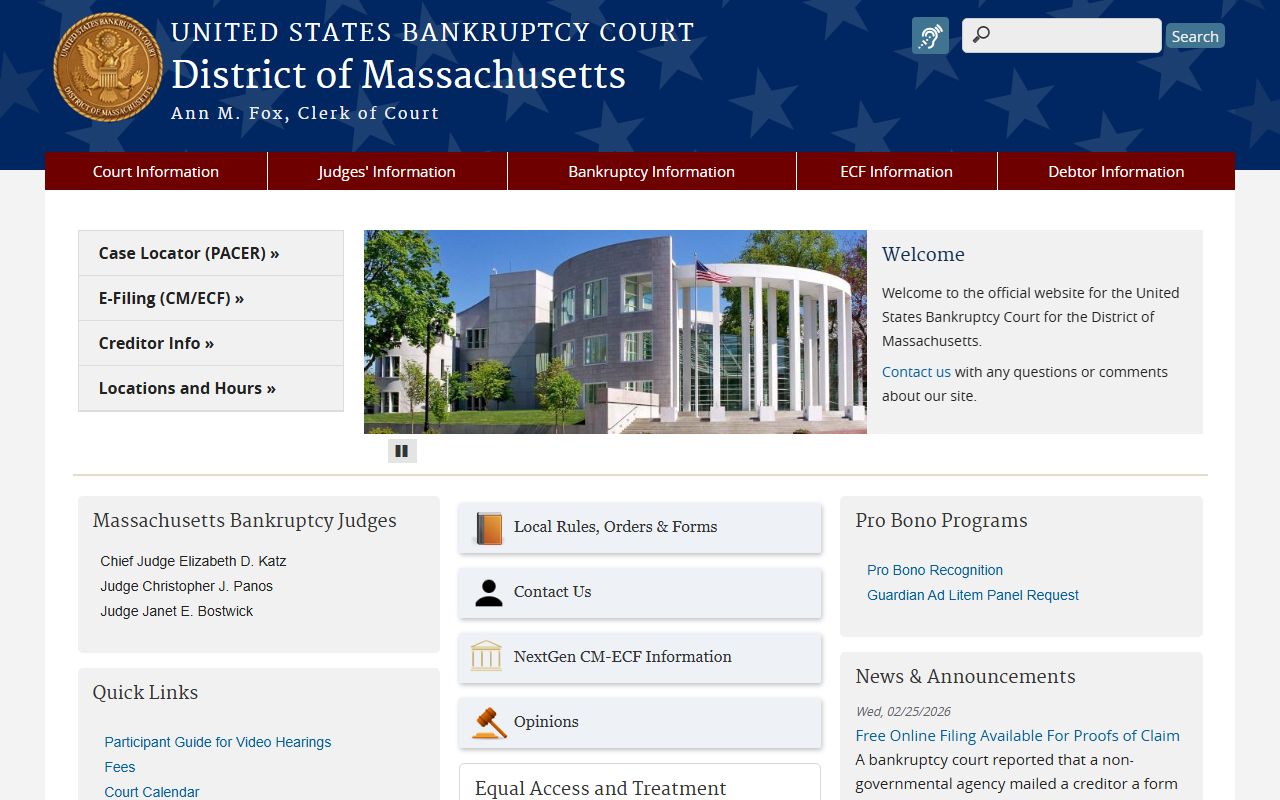
The U.S. Bankruptcy Court for the District of Massachusetts handles all Cambridge bankruptcy filings through the Eastern Division in Boston.
Bankruptcy Chapters Filed by Cambridge Residents
Cambridge residents file under several chapters of the federal bankruptcy code. The chapter you pick depends on your income, the type of debt you have, and what you want to accomplish. Each chapter creates its own set of Cambridge bankruptcy records at the Eastern Division court.
Chapter 7 is the most common. It is a liquidation case. You list all your assets and debts, and a trustee may sell non-exempt assets to pay creditors. Most Chapter 7 cases are "no asset" cases, meaning there is nothing to sell. The discharge under 11 U.S.C. § 727 wipes out most unsecured debts. The filing fee is $338. Cambridge cases typically close within four to six months.
Chapter 13 lets you keep your property and pay back some or all of your debts through a three-to-five year plan. The filing fee is $313. This chapter works well for people who have regular income and want to catch up on a mortgage or car loan. The repayment plan becomes part of the Cambridge bankruptcy record. Creditors can object to the plan, and the court must approve it before payments begin.
Chapter 11 is used mainly by businesses but is also available to individuals with very high debt levels. Cambridge has many tech-sector companies and high-income professionals, and some of those cases end up in Chapter 11. The filing fee is $1,738. Chapter 11 cases can run for years and generate large volumes of Cambridge bankruptcy records in PACER.
Cambridge's high median home value (above $1.1 million) means real estate is a central issue in many local bankruptcy cases. Debtors need to think carefully about the homestead exemption. Under Massachusetts law, you can protect up to $500,000 in home equity if you file a declared homestead deed before filing bankruptcy. Without the declaration, the automatic protection drops to $125,000. The relevant federal statute on exemptions is 11 U.S.C. § 522.
The Automatic Stay and Cambridge Filers
When you file bankruptcy, the automatic stay goes into effect right away. This is one of the most important protections in all of bankruptcy law. The stay comes from 11 U.S.C. § 362. It stops most collection actions the moment your case is filed at the Eastern Division court. Wage garnishments, foreclosure sales, repossessions, and collection calls must all stop. The stay applies even before the court formally processes your Cambridge bankruptcy case.
Cambridge has a high cost of living, and many residents take on significant debt to cover housing and other expenses. When financial pressure gets severe, the automatic stay can provide breathing room. Creditors who violate the stay can face court sanctions. If you believe a creditor has ignored the stay in your Cambridge bankruptcy case, report it to the court right away.
The stay does not last forever. It can be lifted if a creditor files a motion with the court and shows good cause. In Cambridge cases involving high-value real estate, secured creditors sometimes seek relief from the stay if there is little or no equity protecting their interest in a property.
Filing Fees for Cambridge Bankruptcy Cases
Federal filing fees are the same across all of Massachusetts. The fee you pay depends on the chapter you file.
- Chapter 7: $338
- Chapter 13: $313
- Chapter 11: $1,738
If you cannot pay the Chapter 7 fee all at once, you can ask the court to let you pay in up to four installments. There is a form for this request on the court website. Low-income filers may also apply to have the Chapter 7 fee waived entirely. You must show that your income is below 150% of the federal poverty line and that paying the fee is not feasible. The court decides whether to grant the waiver. Chapter 13 fees cannot be waived, but installment payments are available.
Once a case is in the system, getting copies of Cambridge bankruptcy records costs money. A certified copy from the clerk costs $12.00. A document search by the clerk costs $34.00. PACER charges $0.10 per page when you pull records yourself online. For most routine lookups, PACER is the cheapest route. Debtors who need a certified copy of their discharge order should request it from the clerk at the Boston courthouse.
Legal Help for Cambridge Bankruptcy Cases
Several organizations offer free or low-cost legal help to Cambridge residents dealing with bankruptcy. Getting advice before you file can help you pick the right chapter and protect the most property.
The Harvard Legal Aid Bureau serves low-income clients in the Cambridge area. It is located at 23 Everett Street, Cambridge, MA 02138. Call (617) 495-4408 to ask about eligibility. The bureau is staffed by Harvard Law School students working under attorney supervision. It handles a range of civil legal matters, and bankruptcy is among the areas where it can help Cambridge residents.
Harvard Legal Aid Bureau at 23 Everett Street offers free legal help to eligible Cambridge residents facing bankruptcy.
Greater Boston Legal Services is another option. Reach them at (617) 371-1234 or visit gbls.org. They serve low-income individuals and families across the Boston metro area, including Cambridge. Their intake staff can help you figure out if you qualify and what kind of help is available for your Cambridge bankruptcy situation.
The De Novo Center for Justice and Healing is based in Cambridge at 60 Pleasant Street, Cambridge, MA 02139, phone (617) 661-1010. They work with individuals dealing with financial and legal crises. Contact them directly to ask about their current services for Cambridge residents.
The court's own FAQ page at mab.uscourts.gov/faqs-debtors answers common questions about filing without a lawyer. The court also links to the Massachusetts Law page on bankruptcy at mass.gov, which gives an overview of state and federal rules that apply to Cambridge bankruptcy cases.
Discharge and Non-Dischargeable Debts
A discharge is the court order that wipes out your personal liability for listed debts. Getting a discharge is the goal for most people who file Chapter 7 in Cambridge. Once the discharge is entered, creditors can no longer try to collect those debts from you personally. The discharge order becomes part of your Cambridge bankruptcy record and can be retrieved from PACER or from the clerk's office.
Not every debt gets discharged. Under 11 U.S.C. § 523, certain debts survive bankruptcy no matter what. These include most student loans, recent income taxes, child support, alimony, and debts from fraud. Cambridge has a large population of graduate students and young professionals carrying heavy student loan balances. Those debts will generally not go away through a standard Chapter 7 or Chapter 13 filing.
If a creditor believes a specific debt should not be discharged, they must file an adversary proceeding in the Cambridge bankruptcy case before the deadline set by the court. These proceedings have their own dockets in PACER and generate separate Cambridge bankruptcy records. The outcome depends on the facts and can be appealed. Most cases settle without going to a full trial.
Nearby Cities and County
Cambridge is surrounded by other cities that also file bankruptcy cases in the Eastern Division. If you need records from a neighboring community, use PACER the same way you would for Cambridge cases.
Cambridge is part of Middlesex County. For county-level information on bankruptcy filings and related court resources, visit the Middlesex County page.