
Boston Bankruptcy Records
Boston bankruptcy records are filed and maintained at the U.S. Bankruptcy Court for the District of Massachusetts, Eastern Division, located in downtown Boston. As the state capital and the seat of the Eastern Division, Boston handles the largest share of all Massachusetts bankruptcy filings. Whether you need to search an existing case, access public court documents, or learn how to file, this guide covers what you need to know about finding Boston bankruptcy records.
Boston Quick Facts
Boston Bankruptcy Court Location
The U.S. Bankruptcy Court for the Eastern Division sits at 5 Post Office Square, Suite 1150, Boston, MA 02109. This is the John W. McCormack Post Office and Court House. The clerk's office is open Monday through Friday, 8:30 a.m. to 5:00 p.m. Filing is accepted until 4:30 p.m. You can call the court at (617) 748-5300. For emergencies, use (617) 748-5317.
| Court | U.S. Bankruptcy Court, Eastern Division |
|---|---|
| Address | 5 Post Office Square, Suite 1150 Boston, MA 02109 |
| Phone | (617) 748-5300 |
| Emergency | (617) 748-5317 |
| Hours | Mon–Fri, 8:30 AM – 5:00 PM (filing until 4:30 PM) |
| Website | mab.uscourts.gov |
Getting to the courthouse is straightforward by public transit. The Red Line and Orange Line both stop at State Street Station, just a short walk away. The Blue Line Aquarium Station is also close. Green Line riders can get off at Government Center. If you come by commuter rail, South Station and North Station are both within walking distance or a quick bus ride from the court. Parking in downtown Boston is limited and expensive, so transit is usually the better choice.
The court's Boston Division page at mab.uscourts.gov/content/boston lists division-specific information including local contacts and filing guidelines. It is worth checking before your visit to confirm any updated procedures.
The image below shows the U.S. Bankruptcy Court's main website, which is your central resource for Boston bankruptcy records and court information.
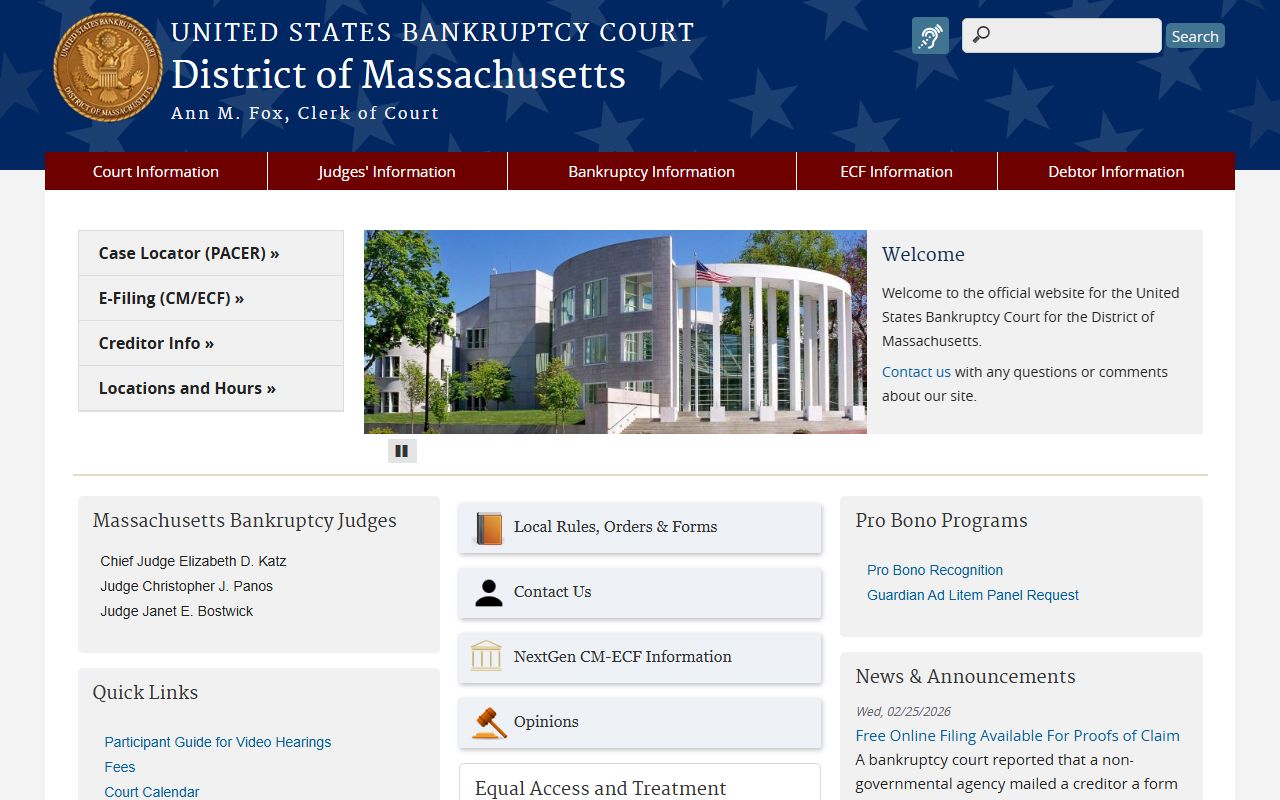
The court site has links to local rules, forms, filing guides, and case search tools.
How to Search Boston Bankruptcy Records
The main tool for searching Boston bankruptcy records is PACER, the federal court's public access system. PACER gives you online access to case dockets, filed documents, and court orders. You can reach it at pacer.uscourts.gov. Access costs $0.10 per page. The maximum charge for any single document is $3.00. If your quarterly charges total less than $30, the court waives the fee. That means light users often pay nothing at all.
To search, log in to PACER and select the District of Massachusetts. You can search by debtor name, case number, Social Security number, or tax ID. Results show the case status, chapter type, filing date, and a full docket list. Each docket entry links to the actual filed document if you want to read it. PACER covers all Boston bankruptcy records going back many years, and the system is available around the clock.
Below is the Boston Division page, which provides local filing instructions and division-specific resources for Boston bankruptcy cases.
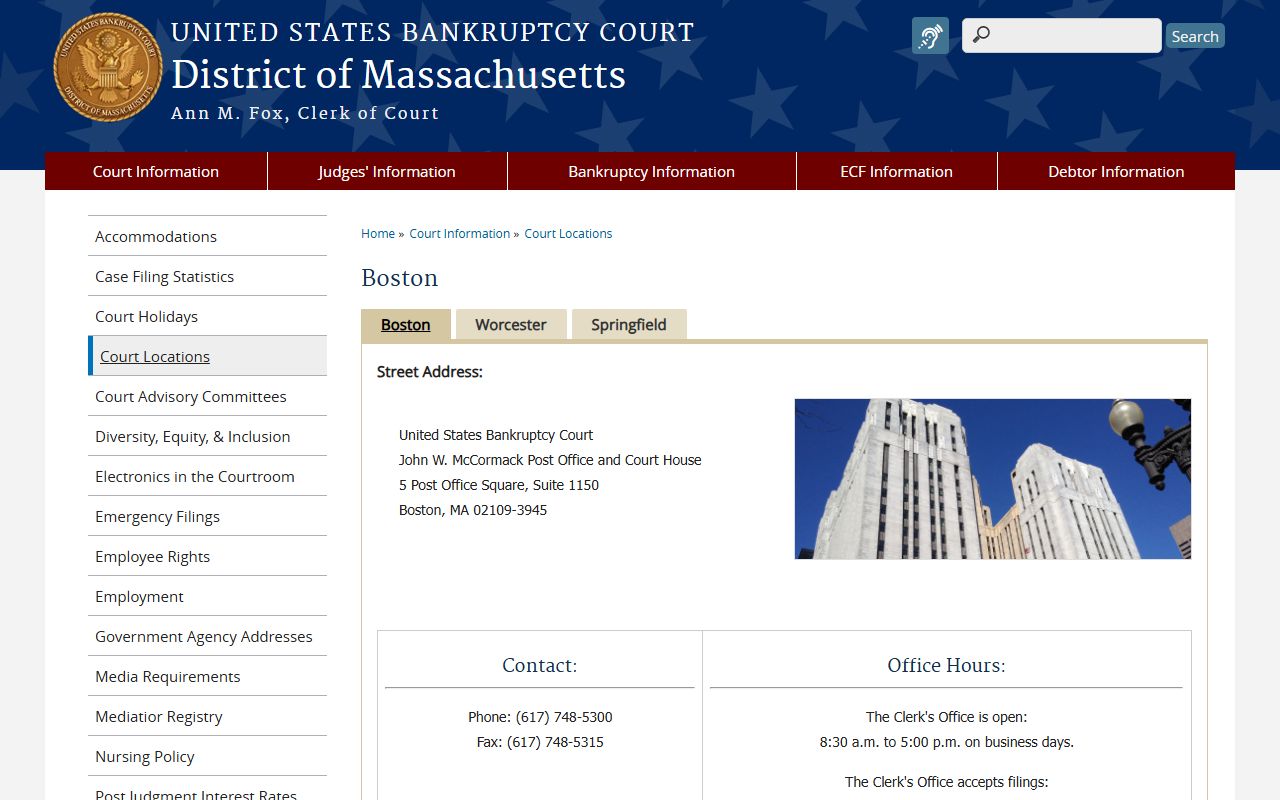
The division page includes contacts, procedural notes, and links to local court resources.
PACER is not the only free option. The court's Voice Case Information System, known as VCIS, lets you search basic case info by phone. Call 1-866-222-8029 and press 1 for Massachusetts. The service is free and runs 24 hours a day. You can get case status, hearing dates, and trustee names without logging into any computer. It is a good backup when you just need quick confirmation about a Boston bankruptcy case.
For in-person access, the clerk's office at 5 Post Office Square allows public terminal searches on-site. Staff can help you find a case if you have a name or case number. Certified copies cost $12.00 each. Regular photocopies run $0.50 per page. A search fee of $34.00 applies if the clerk conducts the search for you.
Chapter Types Filed in Boston
Most Boston bankruptcy records fall under Chapter 7 or Chapter 13. Chapter 7 cases account for roughly 60 to 70 percent of Boston-area filings. Chapter 7 is a liquidation process. It wipes out most unsecured debt in exchange for giving up non-exempt assets. The process typically takes three to six months from filing to discharge. For Boston filers dealing with medical bills or credit card debt, Chapter 7 is often the quickest path.
Chapter 13 is more common among Boston homeowners who want to keep their property. Under Chapter 13, a filer proposes a three- to five-year repayment plan. The plan lets you catch up on mortgage arrears and keep your home. Given the high cost of Boston real estate, Chapter 13 sees significant use here. The Massachusetts homestead exemption protects up to $500,000 of home equity if you have filed a declaration, or $125,000 automatically under 11 U.S.C. § 522. That matters a great deal in a city where home values are among the highest in the country.
Chapter 11 is the business reorganization chapter. Several well-known Boston-area companies have filed Chapter 11 cases through the Eastern Division, including Bertucci's restaurant chain, which filed its third Chapter 11 in 2025. Friendly's, the New England ice cream and restaurant brand, filed in 2020 and again in 2011. These high-profile cases become part of the public Boston bankruptcy records accessible through PACER.
Filing fees for 2024: Chapter 7 is $338, Chapter 13 is $313, and Chapter 11 is $1,738. These fees go to the clerk at filing and do not change based on the size of your debts.
Legal Aid and Assistance in Boston
Several nonprofit organizations in Boston can help low-income filers with Boston bankruptcy cases. Greater Boston Legal Services (GBLS) is the largest. GBLS serves Boston residents who cannot afford an attorney. Their office is at 197 Friend Street, Boston, MA 02114. You can call (617) 371-1234 or toll-free at 1-800-323-3205. Their website is at gbls.org.
Below is a screenshot of the Greater Boston Legal Services website, where Boston residents can apply for free legal help with bankruptcy cases.
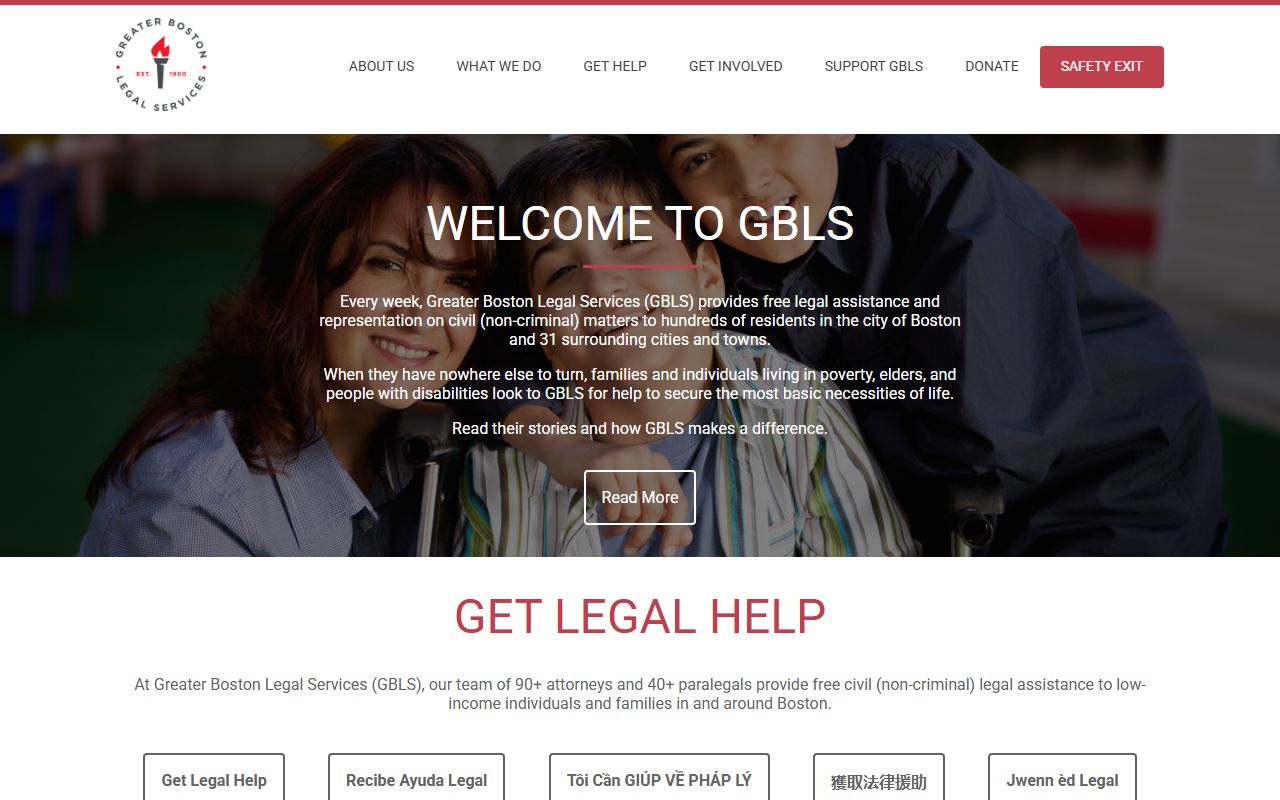
GBLS handles bankruptcy cases for qualifying residents and can guide you through the filing process at no cost.
The Volunteer Lawyers Project (VLP) connects Boston residents with volunteer attorneys who handle bankruptcy matters. Their phone is (617) 603-1700. Find them online at vlpnet.org. The VLP runs legal clinics and can match filers with pro bono counsel. Wait times vary, so contact them early.
The screenshot below shows the Volunteer Lawyers Project site, a key resource for pro bono bankruptcy help in Boston.

VLP matches Boston filers who lack funds with volunteer attorneys experienced in bankruptcy law.
The Harvard Legal Aid Bureau also serves low-income clients from its office at 23 Everett Street, Cambridge, MA 02138. Call (617) 495-4408 for eligibility information. Their focus is Greater Boston and they handle a range of civil matters including bankruptcy. If you are a Boston resident who does not qualify for GBLS, the Harvard bureau may be an option.
The Boston Bar Association also maintains a lawyer referral service. Call (617) 742-0625 or visit bostonbar.org to connect with licensed attorneys. The referral service is not free, but it gives you a starting point to find a bankruptcy lawyer in Boston who fits your budget. Many Boston bankruptcy attorneys offer free initial consultations.
The image below is from the Boston Bar Association website, which offers attorney referrals for Boston bankruptcy cases.
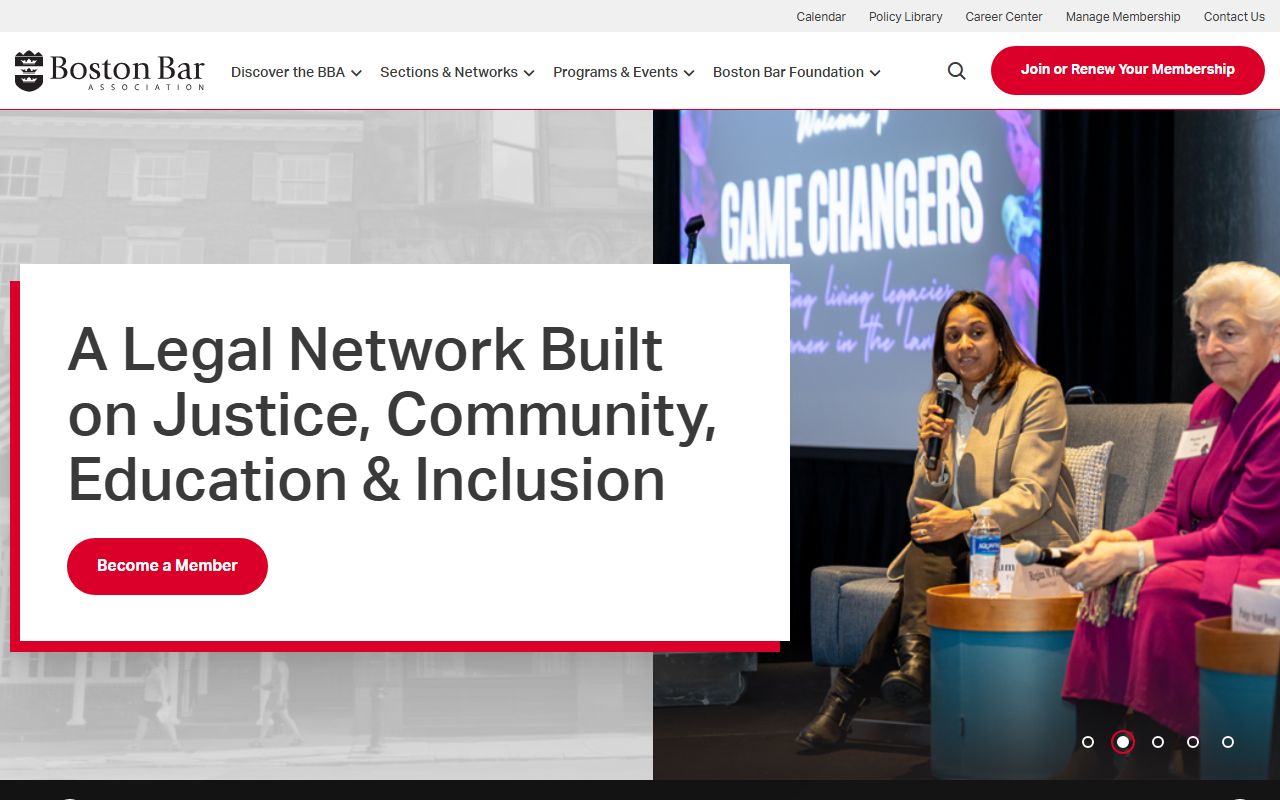
The bar association's referral program can connect you with a Boston bankruptcy attorney.
Filing Without an Attorney in Boston
You can file for bankruptcy in Boston without an attorney. This is called filing pro se. The court allows it, but warns that bankruptcy law is complex and mistakes can hurt your case. The court's debtor information page at mab.uscourts.gov/debtor-information is the best place to start. It lists required forms, fee schedules, and procedural guides.
Pro se filers in Boston can submit documents by paper at the clerk's office or by email to prose_filings@mab.uscourts.gov (as of May 1, 2025). Attorneys must use the electronic CM/ECF system through PACER. Pro se filers are not required to use CM/ECF but may choose to do so. The court's FAQ page at mab.uscourts.gov/faqs-debtors answers common questions about the process.
You must complete a credit counseling course from an approved provider before you file. You also must complete a debtor education course before you can receive a discharge. Both courses are available online. The court's website lists approved providers. Keep your certificates. You need to file them with the court as part of your Boston bankruptcy case.
Massachusetts state law on bankruptcy is summarized at mass.gov/info-details/massachusetts-law-about-bankruptcy. That page covers the interplay between state exemptions and federal bankruptcy law, including the homestead exemption and other protections available to Boston filers.
Key Laws Affecting Boston Bankruptcy Cases
Federal bankruptcy law governs all cases filed in Boston. A few statutes come up often in Boston bankruptcy records. The automatic stay under 11 U.S.C. § 362 takes effect the moment you file. It stops most collection actions, foreclosures, and lawsuits immediately. This is one of the most important protections a Boston filer gets on day one.
Exemptions are governed by 11 U.S.C. § 522. Massachusetts lets filers use state or federal exemptions, whichever set is better for them. The state homestead exemption is a major factor for Boston homeowners because property values are high. Dischargeable debts are listed under 11 U.S.C. § 523, which also defines what debts cannot be wiped out, including most student loans and recent tax debts. The discharge itself is governed by 11 U.S.C. § 727, which sets the conditions under which a Chapter 7 debtor gets relief.
Local rules for the District of Massachusetts can be found at mab.uscourts.gov/local-bankruptcy-rules. These rules govern procedure in Boston bankruptcy cases and supplement the federal rules. Reading them before you file can help you avoid common mistakes that delay or derail cases.
Nearby Cities and County
Boston is in Suffolk County. You can find county-level bankruptcy information and court records on the Suffolk County bankruptcy records page. Suffolk County includes Chelsea, Revere, and Winthrop in addition to Boston.
Other qualifying cities near Boston with their own bankruptcy records pages include Cambridge, Somerville, Everett, Malden, Revere, Quincy, and Brookline. All of these cities are served by the Eastern Division of the U.S. Bankruptcy Court, the same division that handles Boston filings.