
Essex County Bankruptcy Records
Essex County bankruptcy records come from the U.S. Bankruptcy Court for the District of Massachusetts, which handles filings for residents across Salem, Lynn, Lawrence, Haverhill, Peabody, and every other community in the county. Most Essex County cases go through the Eastern Division in Boston, though a few towns along the county's southern and western edges may fall under the Central Division in Worcester. This guide covers how to find those records, what they contain, and where to get help if you need it.
Essex County Overview
U.S. Bankruptcy Court for Essex County
The U.S. Bankruptcy Court for the District of Massachusetts has jurisdiction over all Essex County bankruptcy cases. There is no local courthouse in Essex County itself. Residents file and attend hearings at one of two court locations, depending on which division covers their town. Most Essex County communities fall under the Eastern Division.
The Eastern Division courthouse sits at 5 Post Office Square, Suite 1150, in Boston. The phone number is (617) 748-5300, and the emergency line is (617) 748-5317. This office handles cases from Salem, Lynn, Lawrence, Peabody, Methuen, Andover, North Andover, Beverly, Danvers, Gloucester, Newburyport, and most of the rest of Essex County. If you need to appear in court or file documents in person, this is the location you will most likely use. Hours and specific filing deadlines are listed at mab.uscourts.gov.
The Central Division in Worcester handles a smaller set of Essex County towns. That office is at 595 Main Street, Room 311, Worcester, with a phone number of (508) 770-8900. Towns like Bradford, and certain areas near the county's western boundary, may be assigned to Worcester. If you are not certain which division covers your address, the court's location page at mab.uscourts.gov/court-info/court-locations has a breakdown by city and town.
| Eastern Division (Primary) |
5 Post Office Square, Suite 1150 Boston, MA 02109 Phone: (617) 748-5300 Emergency: (617) 748-5317 |
|---|---|
| Central Division (Some Towns) |
595 Main Street, Room 311 Worcester, MA 01608 Phone: (508) 770-8900 |
| Court Website | mab.uscourts.gov |
How to Find Essex County Bankruptcy Records
PACER is the main tool for searching Essex County bankruptcy records online. PACER stands for Public Access to Court Electronic Records. It is the federal system used by all U.S. bankruptcy courts, including the Massachusetts district. You can search by debtor name, case number, or Social Security number. The cost is $0.10 per page, with a cap of $3.00 per document. If your charges stay under $30 in a quarter, the court waives the fee. Register at pacer.uscourts.gov to get started.
PACER gives you access to the full docket for each Essex County bankruptcy case. That includes the petition, schedules of assets and debts, creditor lists, trustee reports, discharge orders, and any motions or hearings. Records go back many years. Older cases may be partially or fully archived, but the court can retrieve them on request. If you are looking for a specific filing and cannot locate it through PACER, contact the Eastern Division clerk at (617) 748-5300.
There is also a free phone option. The Voice Case Information System, or VCIS, lets you call 1-866-222-8029 at any time, day or night. Press 1 for Massachusetts when prompted. VCIS gives basic case info like the case number, debtor name, filing date, chapter type, trustee name, and discharge status. It costs nothing. This is a fast way to check whether a case exists before paying to pull the full docket on PACER.
For in-person access, you can visit the Eastern Division courthouse in Boston. Public terminals are available in the clerk's office. These terminals provide PACER access at no charge when used on-site. Bring a case number or the debtor's full name. Staff can point you to the right terminal, but they cannot conduct the search for you. Certified copies of Essex County bankruptcy records are available from the clerk for $12.00 each. Plain photocopies cost $0.50 per page, and a search fee of $34.00 applies if the court must search by name rather than case number.
The court's document access page at mab.uscourts.gov/obtain-case-documents explains all methods and fees in detail. Pro se filers who need to submit documents by email can use prose_filings@mab.uscourts.gov, which became active on May 1, 2025.
The Essex County Superior Court at mass.gov and the two Essex Registries of Deeds hold related state-level records. The Southern Registry is at 36 Federal Street in Salem, reachable at (978) 744-1301. The Northern Registry is at 360 Common Street in Lawrence, reachable at (978) 682-2744. These offices do not hold bankruptcy filings, but they do record deeds, liens, and discharges that may connect to bankruptcy cases.
The screenshot below shows the Essex Superior Court location page, which can help you identify the right state court office for related civil matters in Essex County.
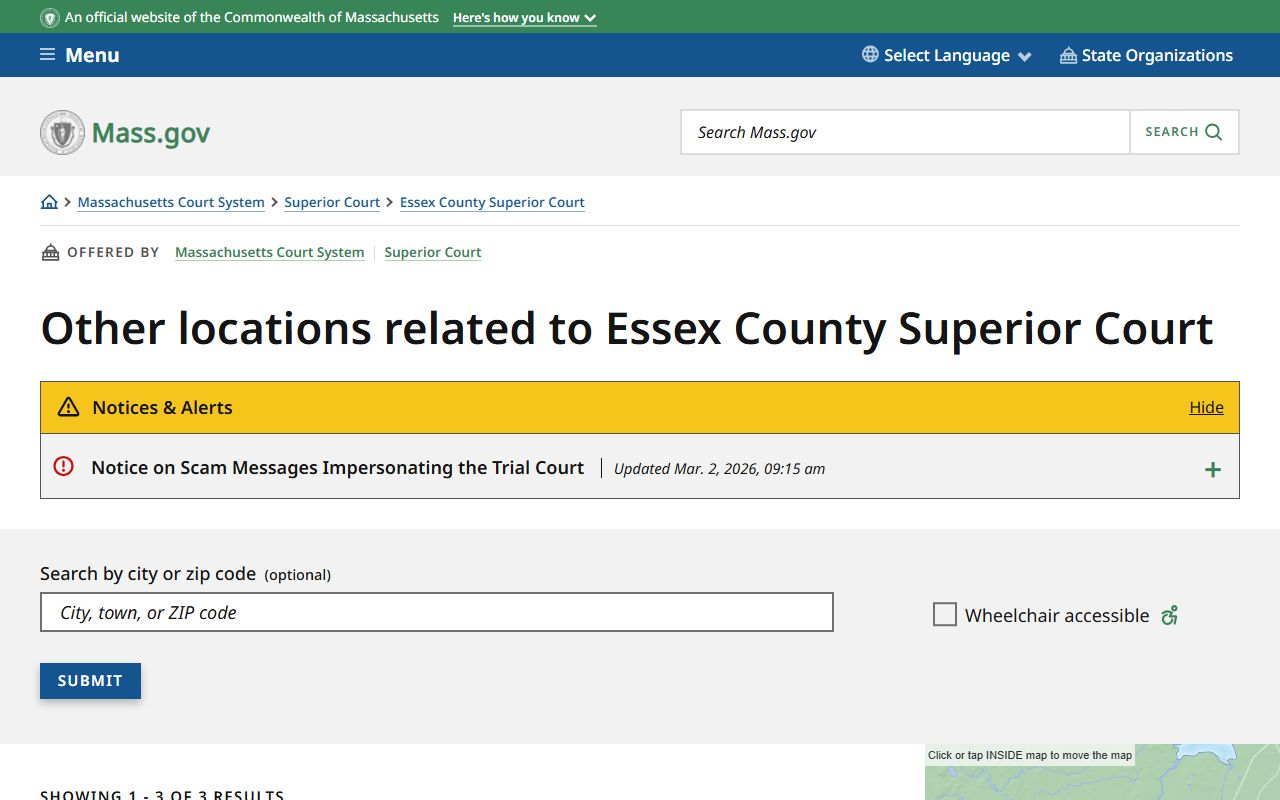
The Essex Superior Court handles civil matters that may intersect with bankruptcy cases, including creditor claims and property disputes.
Types of Bankruptcy Filed in Essex County
Essex County residents file under several chapters of the U.S. Bankruptcy Code. The chapter you file under shapes what the records look like and how the case proceeds. Each type generates its own set of documents, and all of them are accessible through PACER.
Chapter 7 is the most common type in Essex County. It is sometimes called liquidation bankruptcy. The debtor's non-exempt assets, if any, are sold to pay creditors. Most Chapter 7 cases are "no-asset" cases, meaning nothing is sold. The case usually closes within four to six months. The debtor may receive a discharge under 11 U.S.C. § 727, which wipes out most unsecured debts. Filing fee: $338.
Chapter 13 allows debtors with regular income to repay debts over three to five years. Essex County has a higher Chapter 13 rate than the national average, partly because many residents own homes and want to catch up on mortgage arrears. The repayment plan is filed with the court and must be confirmed by a judge. 11 U.S.C. § 522 governs the exemptions a debtor can claim, including Massachusetts' homestead exemption of $500,000 for declared homesteads or $125,000 for automatic ones. Filing fee: $313.
Chapter 11 is used mainly by businesses but is available to individuals with large debts. It involves a reorganization plan approved by creditors and the court. Filing fee: $1,738. Essex County has seen Chapter 11 cases tied to manufacturing, retail, and real estate sectors, reflecting the county's economic history with industries like textiles and shoemaking.
Chapter 12 is for family farmers and fishermen. Given Essex County's coastal communities and fishing industry, some Chapter 12 cases do arise in this area.
The Automatic Stay and What It Means
When any Essex County resident files for bankruptcy, an automatic stay goes into effect immediately under 11 U.S.C. § 362. This is one of the most powerful parts of bankruptcy law. It stops most collection actions the moment the petition hits the court. Wage garnishments, bank levies, foreclosure proceedings, and repossession attempts must all halt. Creditors who violate the stay can face sanctions from the court.
The stay shows up in the bankruptcy docket on PACER as a matter of record. If you are searching Essex County bankruptcy records for a debtor, reviewing the docket for any stay-related motions tells you whether creditors tried to lift the stay and whether the court granted relief. Creditors seeking to resume collection must file a motion for relief from stay, which becomes part of the public record for that case.
Debts That Survive Bankruptcy in Essex County
Not all debts go away in bankruptcy. 11 U.S.C. § 523 lists the types of debts that survive a discharge. These include most student loans, recent tax debts, child support, alimony, and debts from fraud or willful harm. If someone files bankruptcy in Essex County and you are owed one of these types of debt, the discharge does not affect your right to collect. The docket will show whether any creditor filed an adversary proceeding challenging a specific debt's dischargeability.
Legal Help for Essex County Residents
Several organizations offer legal help to Essex County residents dealing with bankruptcy. Northeast Legal Aid has two offices that serve this area. The Lawrence office is at 50 Island Street, Suite 203A, Lawrence, MA 01840, with a phone number of (978) 458-1465. The Lynn office is at 181 Union Street, Suite 201B, Lynn, MA 01901, also reachable at (978) 458-1465. Northeast Legal Aid helps people with low income who cannot afford a private attorney. Their website is northeastlegalaid.org.
The Essex County Bar Association can refer you to private attorneys in the area. Call (978) 741-7888 for the referral line. Rates and services vary, but many attorneys offer a free or low-cost first consultation for bankruptcy cases.
The court itself publishes resources for people who file without an attorney. The FAQ page at mab.uscourts.gov/faqs-debtors covers filing steps, fee waivers, and how hearings work. The local rules page at mab.uscourts.gov/local-bankruptcy-rules has the specific procedural rules for the Massachusetts district. Massachusetts law about bankruptcy, including state-specific exemptions and related statutes, is summarized at mass.gov/info-details/massachusetts-law-about-bankruptcy.
The screenshot below shows the Northeast Legal Aid website, where Essex County residents can apply for free legal help.
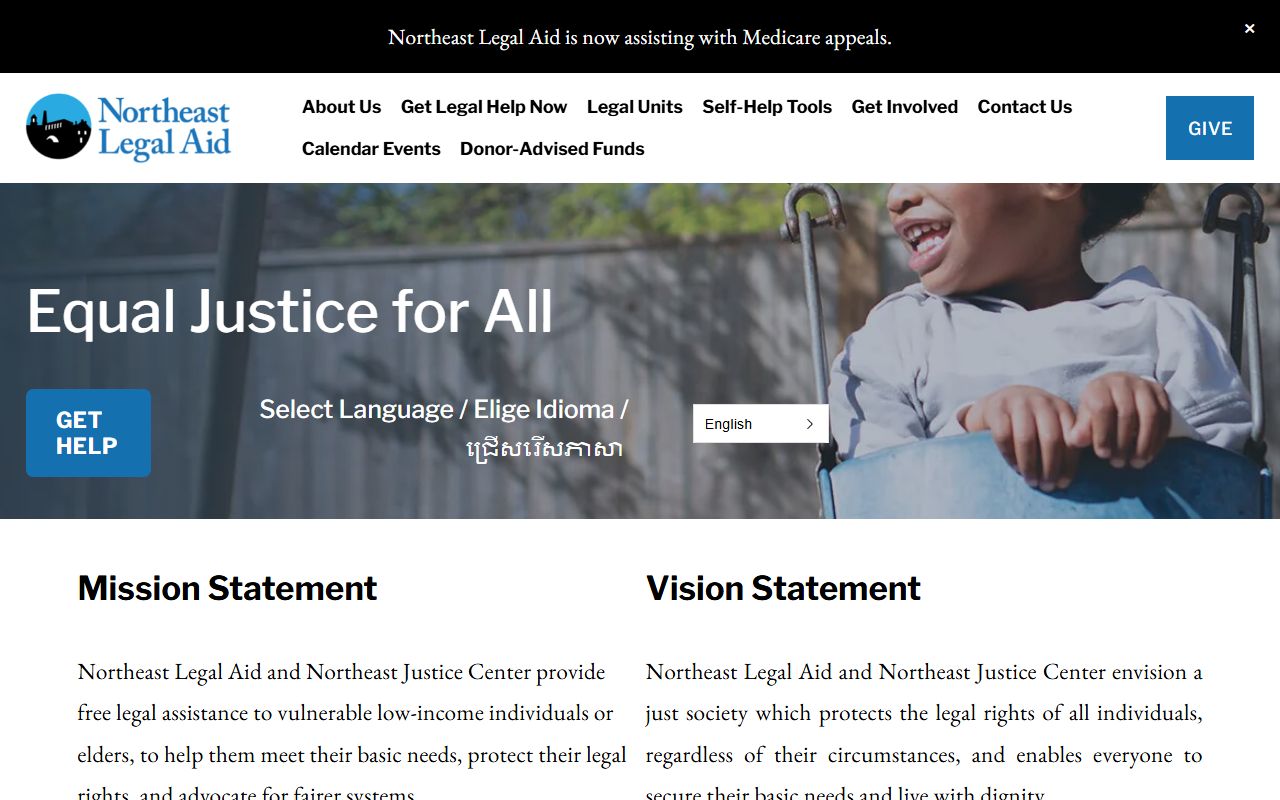
Northeast Legal Aid provides free civil legal services to low-income residents across Essex County, including help with bankruptcy-related matters.
Bankruptcy Patterns in Essex County
Essex County has a long history tied to industries that have gone through cycles of boom and collapse. Haverhill was once known as the "Queen Slipper City" and produced roughly 10 percent of all shoes made in the United States. Over time, multiple shoe manufacturers in the county went bankrupt as the industry shifted overseas. Lawrence, planned as an industrial city in 1845, built its identity around textile mills. Those same mills experienced widespread failures during downturns like the Panic of 1857, when two major textile corporations collapsed with losses exceeding $4 million.
This industrial history matters when you look at current bankruptcy rates. Lawrence has persistently higher unemployment than the rest of Essex County, which drives more Chapter 7 filings from that area. Wealthier communities like Andover see far fewer filings. The income gap across Essex County creates uneven filing patterns that show up clearly in PACER data.
Essex County also tends to have a higher Chapter 13 rate than the national average. Many residents are homeowners who turn to Chapter 13 specifically to save their homes by catching up on mortgage payments over a repayment plan. This is a common reason for filing in the county's suburban and coastal communities.
Qualifying Cities in Essex County
The following cities in Essex County have dedicated bankruptcy records pages. All Essex County cities file cases through the U.S. Bankruptcy Court for the District of Massachusetts. Other communities in the county, including Beverly, Danvers, Gloucester, Newburyport, Methuen, and Andover, do not have separate pages but follow the same filing procedures.
Nearby Counties
Essex County borders three other Massachusetts counties. If you live near a county line, check your address against the court's division assignments before filing.