
Peabody Bankruptcy Records
Peabody bankruptcy records are filed at the U.S. Bankruptcy Court for the District of Massachusetts, Eastern Division, which covers all of Essex County. Peabody is a North Shore city in Essex County, and all bankruptcy cases filed by Peabody residents are processed through the Eastern Division courthouse in Boston. This page explains how to access Peabody bankruptcy records, what types of cases are common, and where local residents can get legal help.
Peabody Quick Facts
Peabody Bankruptcy Court Location
Peabody is in Essex County. All Essex County bankruptcy cases are filed with the Eastern Division of the U.S. Bankruptcy Court. The courthouse is at 5 Post Office Square, Suite 1150, Boston, MA 02109. Phone is (617) 748-5300. The clerk's office is open Monday through Friday, 8:30 a.m. to 5:00 p.m. Filing closes at 4:30 p.m.
| Court | U.S. Bankruptcy Court, Eastern Division |
|---|---|
| Address | 5 Post Office Square, Suite 1150 Boston, MA 02109 |
| Phone | (617) 748-5300 |
| Hours | Mon–Fri, 8:30 AM – 5:00 PM (filing until 4:30 PM) |
| Website | mab.uscourts.gov |
Peabody is about 15 miles north of Boston. The commuter rail stops at Salem, which is a short drive from Peabody. From North Station in Boston, the courthouse at Post Office Square is a 10-minute walk. By car, driving is an option but downtown Boston parking is limited and costly. Check the MBTA schedule before you visit.
The court's main website at mab.uscourts.gov has forms, local rules, fee information, and links to the online case search system. It is the best starting point for any research into Peabody bankruptcy records.
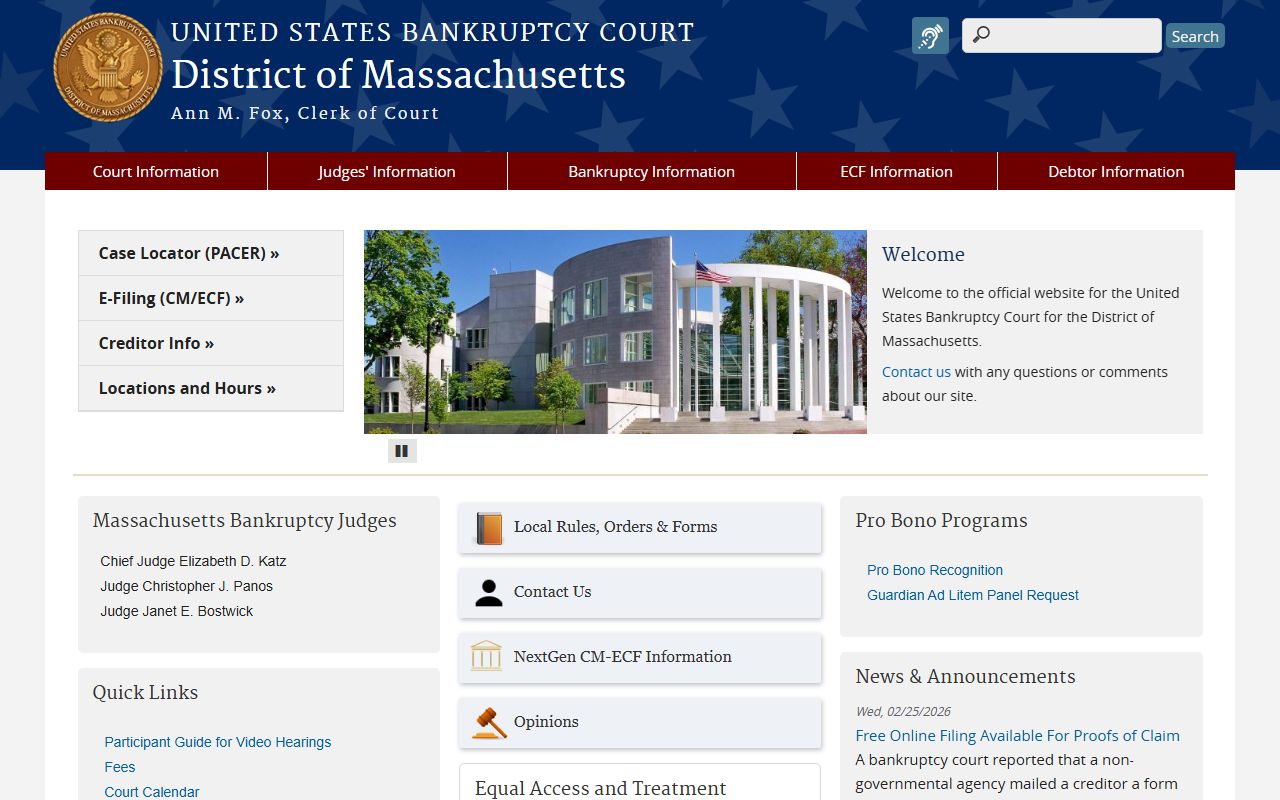
The U.S. Bankruptcy Court site is the primary source for Peabody bankruptcy records, filing guides, and case search access through PACER.
How to Search Peabody Bankruptcy Records
PACER is the main tool for searching Peabody bankruptcy records online. Set up a free account at pacer.uscourts.gov. Access costs $0.10 per page. Quarterly charges under $30 are waived automatically. Most people who search occasionally pay nothing.
Log in and select the District of Massachusetts. You can search by debtor name, case number, the last four digits of a Social Security number, or a tax ID. Results show chapter type, filing date, status, assigned judge, and trustee. Clicking into the docket shows every filed document with links to read them. Peabody bankruptcy records in PACER cover cases going back many years.
The Voice Case Information System (VCIS) is a free phone alternative. Call 1-866-222-8029 and press 1 for Massachusetts. VCIS runs 24 hours a day. It provides basic case status, hearing dates, and trustee names at no charge. No account is needed. It's the fastest way to check on a case without logging in.
In-person searches are available at the clerk's office in Boston during regular business hours. Public terminals let you search and print. Certified copies cost $12.00 each. Photocopies run $0.50 per page. A $34.00 fee applies if you ask the clerk to search for you. Bring a name or case number when you visit.
Bankruptcy Cases Filed in Peabody
Peabody is a North Shore city with a mixed commercial and residential base. Chapter 7 makes up the majority of Peabody bankruptcy records, as it does statewide. Chapter 7 is a liquidation that discharges most unsecured debts in three to six months. It's the quickest way out of credit card debt, medical bills, and personal loans for eligible filers. The means test compares your income to the Massachusetts median to determine if you qualify.
Peabody has a history tied to leather tanning and shoe manufacturing. Many of those industries declined over decades. More recently, retail instability has affected Peabody's commercial landscape. The Northshore Mall is a major retail hub in Peabody, and retail industry bankruptcies have been a factor in both individual and business filings. When retailers close or restructure, local workers and small business suppliers sometimes face financial fallout that ends in bankruptcy filings.
Chapter 13 is available for Peabody homeowners who want to keep their property while catching up on mortgage payments. The Massachusetts homestead exemption protects up to $500,000 in equity if you have filed a declaration with the Essex County Registry of Deeds, or $125,000 automatically under 11 U.S.C. § 522. Filing a declaration before you file bankruptcy is a simple step that can protect a significant amount of equity.
Chapter 11 is the business reorganization chapter. Peabody business owners facing insolvency may use Chapter 11 to restructure debts while continuing operations. Filing fees: Chapter 7 is $338, Chapter 13 is $313, and Chapter 11 is $1,738. All fees go to the court at filing.
Legal Aid and Attorneys in Peabody
Northeast Legal Aid serves Peabody and Essex County residents who need civil legal help but cannot afford an attorney. Call (978) 458-1465 or visit their website at northeastlegalaid.org. Northeast Legal Aid handles bankruptcy matters for qualifying low-income residents throughout northeastern Massachusetts, including Essex County. Eligibility is income-based.
The Essex County Bar Association is also a resource for Peabody residents seeking a referral to a private attorney. Call (978) 741-7888 for referral services. Many Essex County bankruptcy attorneys offer free initial consultations. That first meeting is a good way to understand your options without committing any money upfront.
Joseph Stephen Provanzano is a Peabody-area bankruptcy attorney with over 50 years of experience. He can be reached at (978) 535-8222. Long-tenured local attorneys are often familiar with the patterns of cases in the region and can offer practical insight beyond what you'll find in general legal guides.
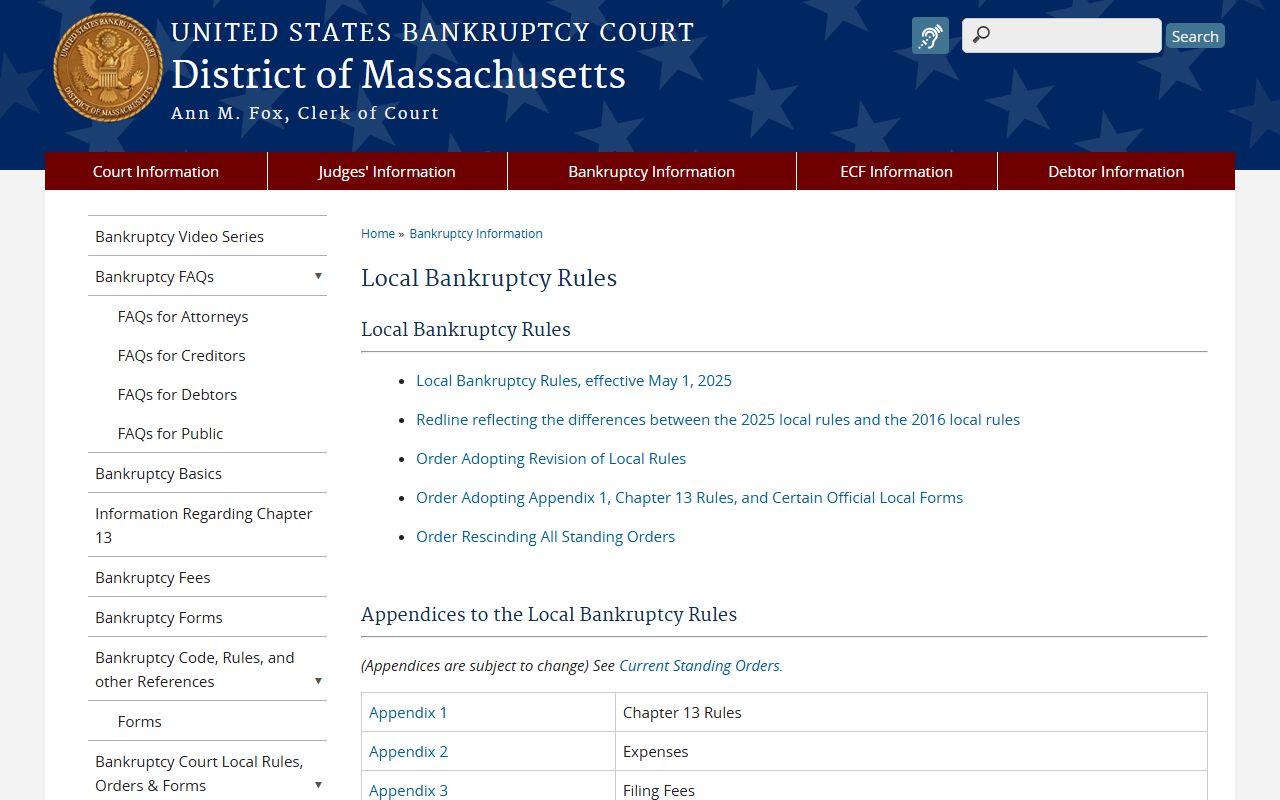
The Massachusetts local bankruptcy rules page covers procedural requirements that apply to all Peabody cases filed through the Eastern Division.
The court's debtor FAQ page at mab.uscourts.gov/faqs-debtors answers common questions about the process. It covers credit counseling requirements, what to expect at the meeting of creditors, and how long each chapter type takes. Review it before you meet with an attorney so you can make better use of that time.
Filing Pro Se in Peabody
You can file bankruptcy without an attorney. Pro se filing is permitted. Peabody residents can submit documents at the clerk's office in Boston or by email to prose_filings@mab.uscourts.gov. The email filing option has been available since May 2025. Attorneys file through CM/ECF; pro se filers are not required to use it but may.
Before filing, you must complete a credit counseling course from a court-approved provider. After the filing but before discharge, you must complete a debtor education course. Both courses are available online. Save the certificates. File them with the court as part of your case. Skipping either course is one of the most common mistakes pro se filers make.
Peabody residents with real estate, business debts, or tax liabilities face more risk when filing without an attorney. Errors in exemption claims or missed filing deadlines can derail your case. Even a single consultation with a bankruptcy attorney is worth the investment if you have any assets to protect.
Massachusetts bankruptcy law is summarized at mass.gov/info-details/massachusetts-law-about-bankruptcy. That page covers how state exemptions interact with federal bankruptcy law, including the homestead protection and how filers choose between state and federal exemption sets.
Federal Laws That Apply to Peabody Cases
All Peabody bankruptcy cases are governed by federal law. Three statutes come up most often. The automatic stay under 11 U.S.C. § 362 takes effect the moment you file. It stops collection calls, lawsuits, wage garnishments, and foreclosures immediately. That protection covers all chapter types.
Exemptions under 11 U.S.C. § 522 determine what property you keep. Massachusetts allows filers to pick between state or federal exemption sets. For most Peabody homeowners, the state set provides better protection because the Massachusetts homestead exemption is more generous than the federal alternative. Non-dischargeable debts under 11 U.S.C. § 523 include student loans, recent taxes, alimony, child support, and debts from fraud. These debts survive a bankruptcy discharge and remain owed after the case closes.
Local rules for the District of Massachusetts apply to all Peabody cases filed through the Eastern Division. Read them at mab.uscourts.gov/local-bankruptcy-rules. These rules add procedural requirements on top of the federal Bankruptcy Rules. Reviewing them before you file can help you avoid mistakes that slow the process.
Nearby Cities and County
Peabody is in Essex County. County-level court information and records are on the Essex County bankruptcy records page. Essex County covers the North Shore and is served entirely by the Eastern Division.
Qualifying cities near Peabody with their own bankruptcy records pages include Lynn, Boston, Lawrence, Haverhill, Somerville, and Everett.