
Find Springfield Bankruptcy Records
Springfield bankruptcy records are maintained at the U.S. Bankruptcy Court for the District of Massachusetts, Western Division, located in downtown Springfield at 300 State Street. Springfield is the seat of the Western Division, which handles filings from all four western Massachusetts counties: Hampden, Hampshire, Franklin, and Berkshire. This guide covers how to search Springfield bankruptcy records, how the court works, what it costs to file, and where Springfield residents can get help.
Springfield Quick Facts
Springfield Bankruptcy Court Location
The U.S. Bankruptcy Court Western Division is at the United States Courthouse, 300 State Street, Springfield, MA 01105-2925. The phone number is (413) 785-6900. Hours are Monday through Friday, 8:30 a.m. to 4:30 p.m. Note that the Western Division closes 30 minutes earlier than the other two divisions. Plan your visit accordingly, especially if you need to file by the deadline.
| Court | U.S. Bankruptcy Court, Western Division |
|---|---|
| Address | 300 State Street Springfield, MA 01105-2925 |
| Phone | (413) 785-6900 |
| After-Hours Emergency | Beeper (800) 759-8888, PIN 1309280 |
| Hours | Mon–Fri, 8:30 AM – 4:30 PM |
| Court Locations Page | mab.uscourts.gov/court-info/court-locations |
After-hours emergencies can be handled through the beeper system listed above. If you face an emergency, such as an imminent foreclosure and need to file to trigger the automatic stay, call the beeper number at (800) 759-8888 and enter PIN 1309280. Court staff will respond to urgent filings outside regular business hours.
The image below shows the court locations page, which provides address and contact information for all three Massachusetts bankruptcy divisions including Springfield.
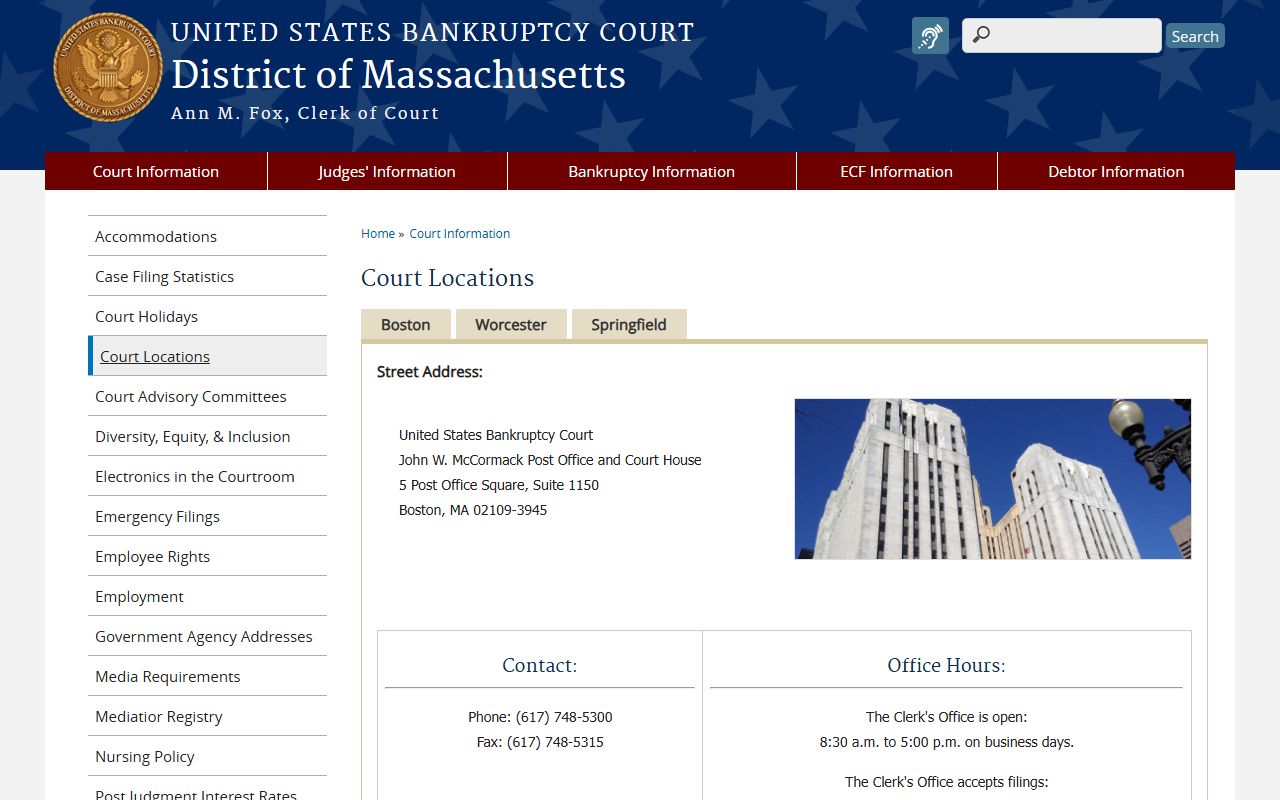
The locations page confirms addresses, hours, and division contacts for the Springfield courthouse and the two other Massachusetts divisions.
Searching Springfield Bankruptcy Records
PACER is the standard tool for searching Springfield bankruptcy records online. Go to pacer.uscourts.gov, create a free account, select the District of Massachusetts, and search by debtor name or case number. Results include case status, chapter type, filing date, trustee assignment, and a full docket of every document filed. Click any docket entry to read the document.
PACER costs $0.10 per page. The maximum charge for one document is $3.00. If your total charges in a calendar quarter come to less than $30, the fee is waived entirely. Most casual searchers pay nothing. Springfield bankruptcy records going back many years are in the system.
You can also call VCIS, the Voice Case Information System, at 1-866-222-8029. Press 1 for Massachusetts. VCIS is free and available 24 hours a day. It gives you basic case info: status, chapter, filing date, hearing dates, and trustee name. No login is needed. It is the fastest way to check whether a Springfield bankruptcy case is active or discharged.
In person, the clerk's office at 300 State Street has public access terminals. Staff can assist with name or case number searches. Certified copies of Springfield bankruptcy records cost $12.00 each. Photocopies are $0.50 per page. A clerk-conducted search costs $34.00. Call (413) 785-6900 before coming to confirm what you need to bring and whether you should schedule an appointment.
Springfield Filings and Local Context
Springfield has the highest poverty rate among major Massachusetts cities, at roughly 26.9 percent. Median household income is around $39,432, the lowest of any large city in the state. These economic pressures translate into a high per-capita rate of bankruptcy filings. Medical debt, credit cards, and utility arrears are common drivers of Springfield bankruptcy cases.
The city's economic history matters here. Springfield was once home to major firearms manufacturing, including Smith and Wesson and Colt. Paper mills and other industrial employers also operated throughout the region. As those industries declined over the past several decades, workers lost stable jobs and benefits. The resulting financial strain is reflected in the volume of Springfield bankruptcy records accumulated over the years. Western Massachusetts as a whole accounts for roughly 15 to 20 percent of all District of Massachusetts filings, with Springfield at the center of that.
Chapter 7 is the most common chapter filed in the Western Division, making up around 70 percent of cases. It is a liquidation process that eliminates most unsecured debts quickly. For Springfield filers with modest income and few assets, Chapter 7 is usually the fastest route to financial relief. Chapter 13 is less common here than in eastern Massachusetts, partly because home values and equity levels are lower, making the Chapter 13 reorganization less necessary for most western MA debtors.
The automatic stay under 11 U.S.C. § 362 is one of the most valuable tools in Springfield bankruptcy cases. It stops foreclosures, repossessions, and collection calls the moment you file. Many Springfield residents file specifically to get this protection while they work out a longer-term plan with the court. Combined with the Massachusetts homestead exemption under 11 U.S.C. § 522, which protects up to $125,000 of home equity automatically (or $500,000 with a declaration), bankruptcy provides real protection for Springfield homeowners who need time.
Legal Aid in Springfield
Community Legal Aid operates a Springfield office at One Monarch Place and handles bankruptcy cases for qualifying low-income residents. Call (413) 781-7814 to reach the Springfield intake line. Intake hours are Monday, Tuesday, Thursday, and Friday from 9:30 a.m. to 12:15 p.m., and Wednesday from 1:30 p.m. to 4:15 p.m. Their main site is communitylegal.org. Community Legal Aid is the largest free legal provider in western Massachusetts and handles a high volume of bankruptcy cases in the Springfield area.
Below is a screenshot from the Community Legal Aid website, which serves Springfield and surrounding communities throughout western Massachusetts.
Community Legal Aid provides free legal help to income-eligible Springfield residents facing bankruptcy.
The Hampden County Legal Clinic is at 50 State Street, Springfield, MA 01103. Call (413) 733-6500. Their site is hcbarlegalclinic.org. The clinic offers brief advice and referrals for civil legal matters including bankruptcy. It is a good place to get a quick read on your options before deciding whether to file and which chapter to use.
The Hampden County Bar Association, reachable at (413) 732-4648 and at hcbar.org, maintains a lawyer referral program. If you need a private bankruptcy attorney in Springfield, the bar association can connect you with someone in the area. Many Springfield bankruptcy attorneys offer free initial consultations and flat-fee Chapter 7 services.
The image below is from the Hampden County Bar Association website, where Springfield residents can find attorney referrals for bankruptcy and other civil legal matters.
The bar association's referral service connects Springfield residents with licensed attorneys who handle bankruptcy cases in western Massachusetts.
Filing Bankruptcy in Springfield
Before you file, you must complete a credit counseling course from a court-approved provider. The course can be taken online and typically takes one to two hours. Keep the certificate. You need to submit it when you file. A second course, debtor education, is required before you receive a discharge at the end of your case. Both courses are available from approved online providers listed on the court's website.
Attorneys file electronically through CM/ECF, accessed via PACER. Pro se filers can submit documents in person at the clerk's office at 300 State Street, by mail, or by email at prose_filings@mab.uscourts.gov as of May 1, 2025. Filing fees are the same statewide: $338 for Chapter 7, $313 for Chapter 13, and $1,738 for Chapter 11. Fee waivers are available for Chapter 7 filers with income below 150 percent of the federal poverty line. Installment payments are also available if you cannot pay all at once.
After filing, the court assigns a trustee and schedules the 341 Meeting of Creditors, usually about 30 days out. You must attend the 341 meeting in person and bring a government-issued photo ID plus your Social Security card or a document showing your full SSN. The trustee reviews your documents and asks questions. Creditors may attend but rarely do in consumer cases. After the meeting, the discharge period begins.
Discharge under Chapter 7 typically comes 60 to 90 days after the 341 meeting, if no objections are filed. Chapter 13 takes three to five years. Throughout either process, your case file becomes part of the public Springfield bankruptcy records accessible via PACER.
Debts that cannot be discharged are listed in 11 U.S.C. § 523. These include most student loans, child support, alimony, and taxes owed within three years of filing. The discharge itself is governed by 11 U.S.C. § 727. Local rules at mab.uscourts.gov/local-bankruptcy-rules supplement federal procedure for all Springfield cases. The court's FAQ page at mab.uscourts.gov/faqs-debtors answers common questions from debtors. Massachusetts state bankruptcy law is summarized at mass.gov/info-details/massachusetts-law-about-bankruptcy.
Nearby Cities and County
Springfield is in Hampden County. You can find county-level court information on the Hampden County bankruptcy records page. Hampden County covers Springfield and the surrounding area, all served by the Western Division courthouse on State Street.
Other qualifying Massachusetts cities with bankruptcy records pages include Chicopee, which is directly adjacent to Springfield and also served by the Western Division. For cities in central and eastern Massachusetts, see Worcester and Boston.