
Search Hampden County Bankruptcy Records
Hampden County bankruptcy records are public documents filed with the U.S. Bankruptcy Court for the District of Massachusetts, Western Division, located in Springfield. Unlike most Massachusetts counties, Hampden County has a local bankruptcy courthouse. Residents of Springfield, Chicopee, Holyoke, Westfield, Agawam, and every other Hampden County community file and appear locally, without the long drive to Boston that filers in eastern counties face.
Hampden County Bankruptcy Records at a Glance
The Western Division Courthouse in Springfield
Hampden County bankruptcy cases are handled at the United States Courthouse at 300 State Street, Springfield, MA 01105-2925. Phone: (413) 785-6900. Fax: (413) 785-6901. The courthouse is open Monday through Friday from 8:30 a.m. to 4:30 p.m. For after-hours emergency filings, use the beeper line at (800) 759-8888 with PIN 1309280. The building is accessible from Interstate 91 and Interstate 291, and PVTA buses serve the area if you are not driving.
Hampden County is the most populous county in western Massachusetts. With roughly 460,000 residents, it generates the highest number of bankruptcy filings in the four-county Western Division. The other three counties in the Western Division are Hampshire, Berkshire, and Franklin. Western Massachusetts as a whole accounts for an estimated 15 to 20 percent of all District of Massachusetts bankruptcy filings in a typical year. For Hampden County specifically, the economic conditions in Springfield push filings above what population alone would predict.
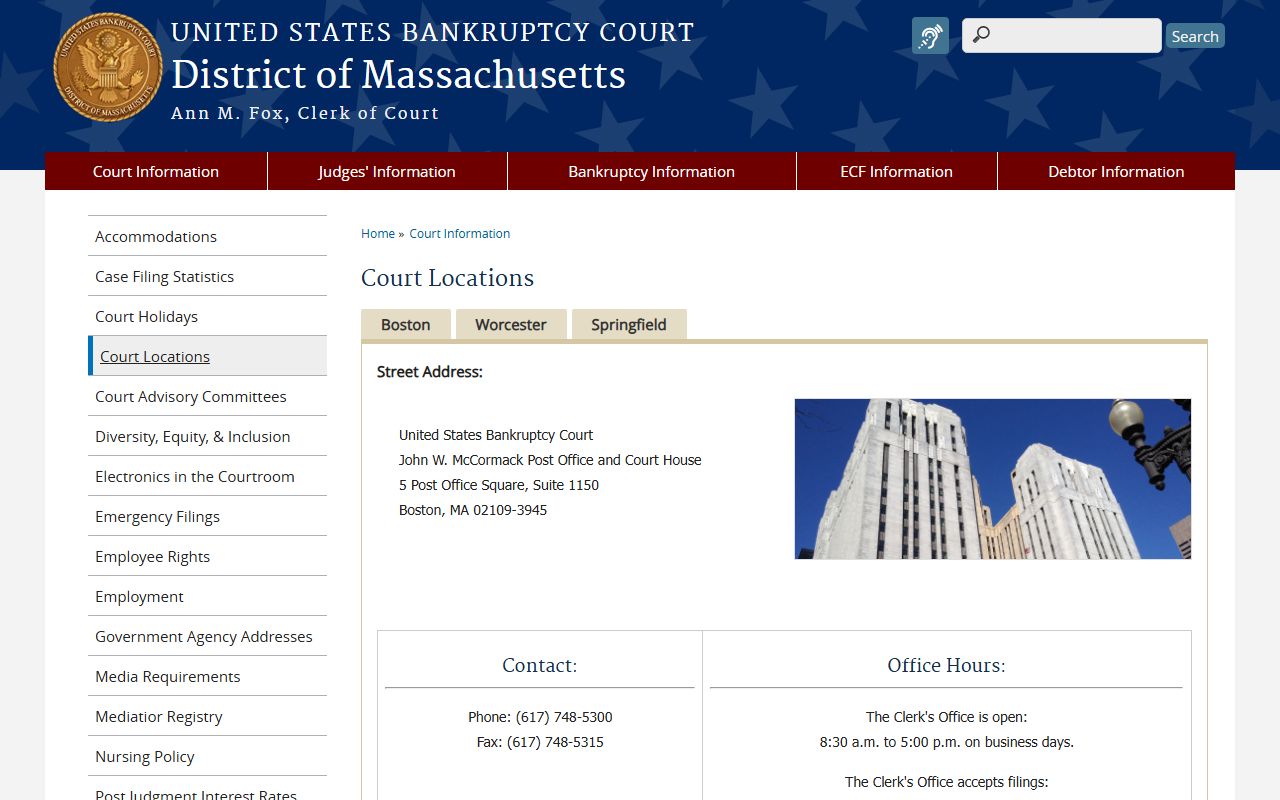
The image above is from the court locations page at mab.uscourts.gov. It shows the Springfield courthouse address and contact information for the Western Division. The courthouse has served Hampden County bankruptcy cases for over a century, and its historic State Street location is well known to local attorneys and trustees.
Springfield has a poverty rate of 26.9 percent, the highest of any major city in Massachusetts. Median household income sits around $39,432. Those numbers drive demand for bankruptcy relief. Chapter 7 accounts for roughly 70 percent of all Hampden County filings. Chapter 13 covers most of the rest. Chapter 11 business cases are less common but do occur, especially in years with notable local business closures.
How to Search Hampden County Bankruptcy Records
PACER is the primary online tool for searching Hampden County bankruptcy records. Register at pacer.uscourts.gov. Once you have an account, select the U.S. Bankruptcy Court for the District of Massachusetts and search within the Western Division. You can search by debtor name, case number, Social Security number, or tax ID. PACER gives you access to the full docket, filed documents, creditor lists, and discharge orders. Cost is $0.10 per page with a $3.00 cap per document. Accounts with quarterly charges under $30 are not billed.
The free VCIS phone line is a good option if you just need basic case information. Call 1-866-222-8029 and press 1 for Massachusetts. The system runs 24 hours a day, seven days a week, except for routine Monday morning maintenance from 7:30 to 8:30 a.m. Enter the debtor name, case number, Social Security number, or tax ID. VCIS returns the case number, chapter type, filing date, trustee, judge, 341 meeting date, and case status. No registration is needed. There is no charge.
In person, the Springfield courthouse has public viewing terminals where you can access records at no cost. Printing costs $0.10 per page. Certified copies of documents cost $12.00 each. To request records by mail, write to the clerk at 300 State Street, Springfield, MA 01105. Include the case name, case number, and a cashier's check or money order payable to "Clerk, United States Bankruptcy Court." The search fee for mail requests is $34.00. The clerk does not accept personal checks for fee payments.
Hampden County Bar Association and Legal Clinic
The Hampden County Bar Association supports the local legal community and offers resources for residents seeking attorney referrals. Their phone number is (413) 732-4648. The bar association also runs the Western Massachusetts Dial-A-Lawyer program, available monthly from 3:30 to 7:30 p.m. at (413) 782-1659. Check the bar website at hcbar.org for current program dates.
The image above is from hcbar.org. The Bar Association established a Foreclosure Task Force in 2008, offering free public clinics during the height of the mortgage crisis. That kind of local legal infrastructure remains active today. For bankruptcy-specific help, the bar's referral service connects you with licensed attorneys who practice in the Western Division.
The Hampden County Legal Clinic operates separately at 50 State Street, Springfield, MA 01103. Phone: (413) 733-6500. Email: legalclinic@hcbar.org. Their website is hcbarlegalclinic.org. The clinic provides free and low-cost legal assistance to qualifying residents. Staff can help identify whether bankruptcy is an appropriate option and, in some cases, assist with the filing process itself.
The image above is from hcbarlegalclinic.org. The clinic's services are particularly relevant to Hampden County filers because the county has a high proportion of residents who may qualify based on income. With Springfield's poverty rate at 26.9 percent, many residents meet the income thresholds for free or reduced-cost legal assistance.
Community Legal Aid
Community Legal Aid serves central and western Massachusetts, including Hampden County. Their Springfield office is at One Monarch Place, Springfield, MA. Phone: (413) 781-7814. Website: communitylegal.org. Intake hours are Monday, Tuesday, Thursday, and Friday from 9:30 a.m. to 12:15 p.m., and Wednesday from 1:30 p.m. to 4:15 p.m. Community Legal Aid handles civil matters only and focuses on low-income clients. Bankruptcy falls within their scope of services for qualifying Hampden County residents.
The image above is from communitylegal.org. Community Legal Aid is one of the most accessible free legal resources for Hampden County residents who cannot afford private attorney fees. Their statewide intake line, available at (855) 252-5342, handles initial screening. The Springfield office focuses on serving the Pioneer Valley region, which includes all of Hampden County.
For those who want to file without any attorney, the Springfield courthouse maintains a self-help area and the court's debtor information pages cover the basics. As of May 1, 2025, pro se debtors can email PDF filings to prose_filings@mab.uscourts.gov. The court's FAQ page at mab.uscourts.gov/faqs-debtors is a practical starting point. The Springfield Law Library at 50 State Street, Springfield, MA 01103, phone (413) 748-7923, provides access to legal research tools and federal bankruptcy codes for self-represented filers.
Exemptions and Discharge for Hampden County Filers
Hampden County filers choose between Massachusetts state exemptions and federal exemptions under 11 U.S.C. § 522. You pick one set. You cannot mix them. Most filers with real estate choose the Massachusetts state exemptions because the homestead protection is so strong. With a declaration of homestead recorded at the Hampden County Registry of Deeds at 436 Dwight Street, Springfield, MA 01103, phone (413) 755-1722, you protect up to $500,000 in home equity. Without a recorded declaration, the automatic homestead still protects $125,000.
Other state exemptions available to Hampden County filers: up to $7,500 in vehicle equity (or $15,000 if you are over 60 or have a disability), up to $15,000 in clothing, up to $15,000 in household furniture, and up to $5,000 in tools of your trade. Retirement accounts tied to public employment are fully exempt under Massachusetts law. IRAs are protected up to $1,362,800 under federal rules. These protections matter most to Hampden County filers who have built up some assets despite financial stress.
The automatic stay under 11 U.S.C. § 362 takes effect the instant a petition is filed. It stops collection calls, wage garnishment, lawsuits, and most foreclosure actions for the life of the case. Hampden County homeowners in foreclosure who file Chapter 13 can use the stay to halt proceedings immediately. The stay gives time to propose and confirm a repayment plan before the foreclosure can resume.
Certain debts cannot be discharged. Under 11 U.S.C. § 523, most student loans, child support, recent tax debt, and debts from fraud survive even a successful bankruptcy. For Chapter 7 cases, the discharge rules are in 11 U.S.C. § 727. A debtor who cooperates with the trustee, passes the means test, and does not hide assets typically receives a discharge order within three to four months of filing. That discharge order is part of the permanent public case record, searchable by anyone through PACER or by phone through VCIS.
Economic Context and Filing Patterns in Hampden County
Hampden County has a long industrial history centered on Springfield. The city was a manufacturing hub for firearms, paper, and textiles. The decline of those industries, particularly the downturn of the firearms sector that once employed thousands at firms like Smith and Wesson, left lasting economic gaps. As manufacturing jobs left, bankruptcy filings rose. That cycle has repeated across different industries and different decades, but the underlying dynamic, job loss leading to debt leading to bankruptcy, remains consistent in Hampden County.
The Western Massachusetts region accounts for 15 to 20 percent of all District of Massachusetts bankruptcy filings annually. Hampden County drives the bulk of those because of its size and the economic challenges concentrated in Springfield and Holyoke. Chapter 7 makes up roughly 70 percent of filings. Chapter 13 is used by residents who have income and want to save property. The presence of a local courthouse in Springfield, unlike many other Massachusetts counties that must travel to Boston, makes in-person filing more accessible for Hampden County residents.
The court's location on State Street has handled Hampden County cases for over a century. Local attorneys, trustees, and judges bring deep familiarity with the economic conditions of the Pioneer Valley. That local knowledge can matter when a trustee or judge evaluates the particular circumstances of a Hampden County case. The Massachusetts state law overview page explains how state and federal law intersect for Massachusetts filers across all counties, including Hampden.
Browse Nearby Counties and Cities
Nearby Counties
- Hampshire County Bankruptcy Records
- Berkshire County Bankruptcy Records
- Franklin County Bankruptcy Records
Cities in Hampden County
The following qualifying cities in Hampden County have dedicated bankruptcy records pages: