
Find Bankruptcy Records in Plymouth County
Plymouth County bankruptcy records are federal court documents maintained by the U.S. Bankruptcy Court for the District of Massachusetts, Eastern Division in Boston. Every case filed by a Plymouth County resident or business, whether in Brockton, Plymouth, Bridgewater, or Marshfield, is held at the Boston courthouse and searchable online through PACER or by phone through the free VCIS system.
Plymouth County Bankruptcy Records at a Glance
Where Plymouth County Cases Are Filed
Plymouth County has no local bankruptcy courthouse. All cases go to Boston. The courthouse address is 5 Post Office Square, Suite 1150, Boston, MA 02109. Phone: (617) 748-5300. Emergency filings after hours go through (617) 748-5317. Hours are Monday through Friday, 8:30 a.m. to 5:00 p.m., with the filing window closing at 4:30 p.m. Plymouth County is entirely within the Eastern Division. That means every resident and business in the county, from Duxbury to Bridgewater, files in Boston.
This matters if you need to appear in court. The drive from Plymouth town center to Boston runs about 45 to 50 miles depending on traffic. Brockton is closer, roughly 30 miles from the courthouse, but still requires a trip north. For routine matters like searching a record or requesting a copy, you can avoid the drive by using PACER online or the VCIS phone line. But hearings, 341 creditor meetings, and in-person clerk visits all require going to Boston.
The court's locations page has the full contact and hours information for all three divisions. The Eastern Division page also notes that 341 meetings may be held at a location other than the courthouse. Confirm your meeting address from your filed documents or directly with the trustee.
Plymouth County Registry of Deeds
The Plymouth County Registry of Deeds is a state-level office, not a federal one, and it does not hold bankruptcy case files. But it is closely connected to bankruptcy proceedings for homeowners. When a debtor files a declaration of homestead before filing for bankruptcy, that declaration is recorded at the Registry. The homestead protects up to $500,000 in home equity under Massachusetts law for those with a recorded declaration. Without the declaration, the automatic homestead provides only $125,000 in protection.
The Registry is at 50 Obery Street, Plymouth, MA 02360. Phone: (508) 830-9200. Their website at plymouthdeeds.org provides an online search tool for deeds, mortgages, and liens recorded in Plymouth County. If you are researching a bankruptcy case that involved real property, checking the Registry for any homestead declaration, deed transfers, or lis pendens filings can fill in important pieces of the picture.
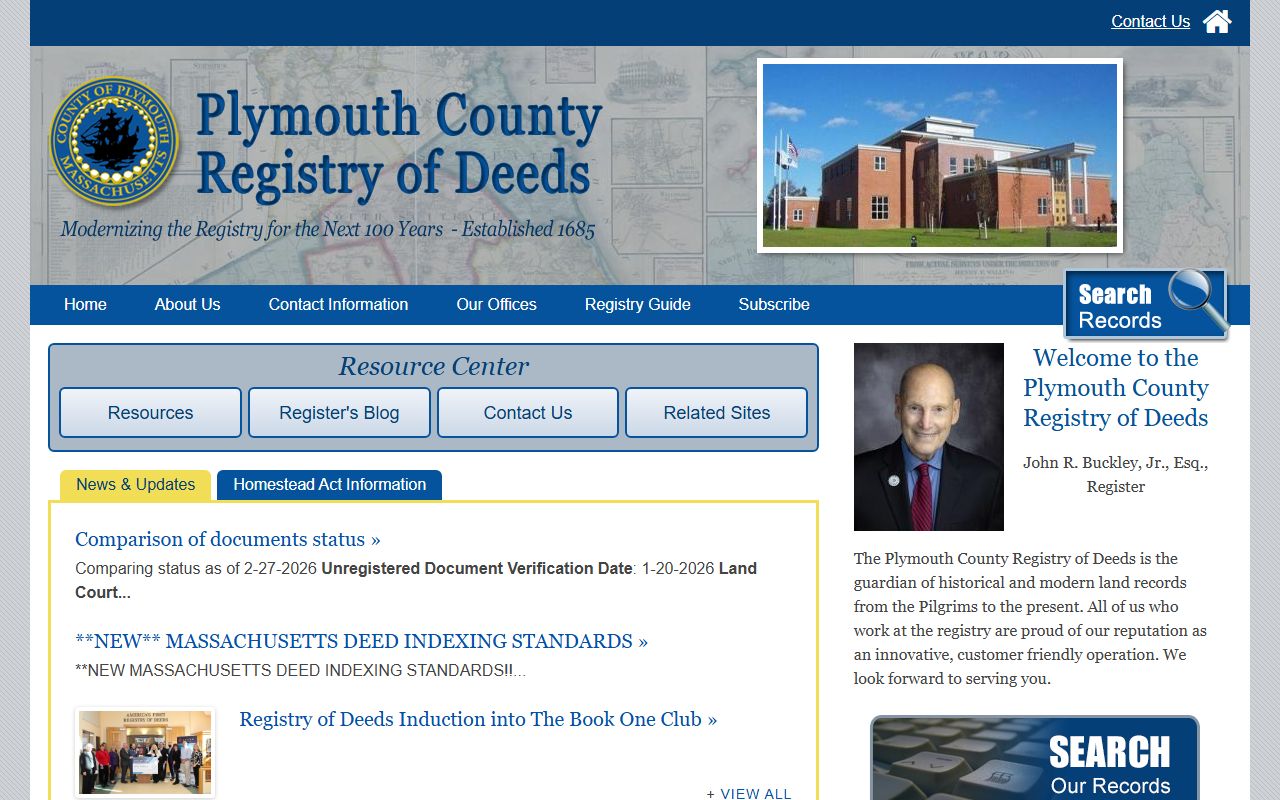
The image above is from plymouthdeeds.org. The Registry's online portal lets you search by name, address, or document type. Recorded homestead declarations, which protect home equity in bankruptcy, are filed here before a bankruptcy case is ever opened. For Plymouth County homeowners considering filing, recording a homestead declaration at this office before the bankruptcy filing is often one of the most important steps an attorney will recommend.
How to Search Plymouth County Bankruptcy Records
PACER is the main tool. Register for a free account at pacer.uscourts.gov. Once you log in, select the U.S. Bankruptcy Court for the District of Massachusetts. Search by debtor name, case number, or Social Security number. You will see the docket, filed documents, creditor lists, and any discharge order. The cost is $0.10 per page, capped at $3.00 per document. Quarterly charges under $30 are waived, so many casual researchers pay nothing.
The Voice Case Information System is free and does not require an account. Call 1-866-222-8029. Press 1 for Massachusetts. The system is available around the clock. Enter the debtor's name, case number, Social Security number, or tax ID. VCIS returns the case number, filing date, chapter type, trustee, judge, 341 meeting date, and discharge date if applicable. The system may be offline on Monday mornings from 7:30 to 8:30 a.m. for maintenance.
In-person access is available at the clerk's office in Boston. Public terminals let you view records at no charge. Printing costs $0.10 per page. Certified document copies cost an additional $12.00 per document. To request records by mail, write to the clerk at the Boston address. Include the case name, case number, and a cashier's check or money order for the search fee of $34.00 plus any copy costs. The clerk does not accept personal checks.
Old or closed Plymouth County cases may have been transferred to the National Archives. The Federal Records Center for Massachusetts is at 380 Trapelo Road, Waltham, MA 02452. Use NATF Form 90 for requests. Fees are $10 per order plus $9.90 retrieval and $0.65 per page.
Plymouth District Court
State courts in Plymouth County do not process bankruptcy filings. Those go to Boston. But state district courts handle related matters that often come before or alongside a bankruptcy case. Civil judgments from state court creditors, for example, can become part of the bankruptcy creditor list. Foreclosure proceedings often start in state court before a bankruptcy filing triggers the automatic stay.
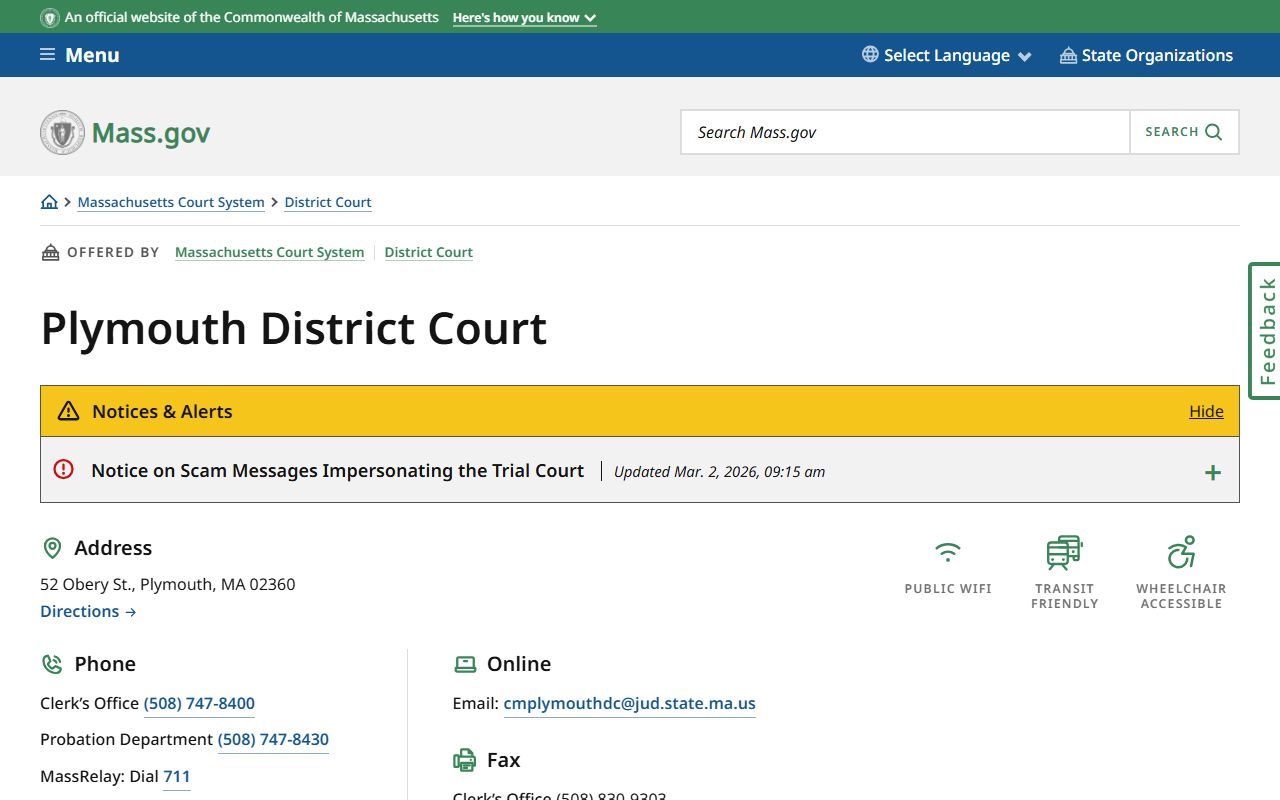
The image above is from the Plymouth District Court page on mass.gov. State court records are separate from bankruptcy records. If you need civil records from state courts in Plymouth County, contact those offices or use the Massachusetts Trial Court's online portal. The district court handles civil claims, small claims, and criminal matters but not bankruptcy cases directly.
Knowing your way around both the state and federal court systems matters when a financial situation involves multiple proceedings. A bankruptcy attorney familiar with Plymouth County can help you sort out which cases belong in which courts and how the automatic stay under 11 U.S.C. § 362 affects any open state court actions.
Plymouth County Bankruptcy History and Context
Plymouth County has a long connection to bankruptcy law. Brockton, once known as "Shoe City," was home to a thriving footwear manufacturing industry. The decline of that industry through the 1970s and 1980s drove waves of both business and personal bankruptcy filings as factories closed and workers lost income. That pattern repeated in other Plymouth County communities tied to manufacturing as the regional economy shifted toward services over the following decades.
A historically significant Plymouth County bankruptcy case reached the U.S. Supreme Court in 1932: MacDonald v. Plymouth County Trust Co. That case helped establish foundational principles around federal bankruptcy jurisdiction, principles that still shape how cases are administered today. While the practical details differ, the underlying framework connecting federal courts to local financial distress that the case addressed remains relevant to every Plymouth County filer.
The 2008 financial crisis hit Plymouth County hard. Residential mortgage foreclosures spiked as home values fell sharply across Southeastern Massachusetts. Chapter 13 filings increased as homeowners tried to save their homes through repayment plans rather than giving up equity in Chapter 7. The pattern continues: when local economic stress rises, Plymouth County bankruptcy filings follow. The 2024 statewide jump of 21.6%, to 4,704 total filings, reflected a similar dynamic as pandemic-era protections expired across Massachusetts.
Types of Bankruptcy Cases Filed in Plymouth County
Chapter 7 is the most common type. A trustee reviews assets, liquidates what is not protected by exemptions, and pays creditors. Remaining eligible debts get discharged. The discharge rules are set out in 11 U.S.C. § 727. A Plymouth County debtor who qualifies, passes the means test, and cooperates with the trustee typically receives a discharge within three to four months of filing. The filing fee is $338. Fee waivers are available on Form 103B for those with income under 150% of the federal poverty guideline.
Chapter 13 is the second most common type. It is available to those with regular income who want to keep property, including a home, while restructuring debt payments. You file a repayment plan covering three to five years. The trustee and creditors may object. A judge confirms the plan if it meets the requirements. The filing fee is $313. Chapter 13 is especially common in Plymouth County for homeowners trying to catch up on mortgage arrears and avoid foreclosure.
Chapter 11 applies to businesses and individuals with complex debt. It involves a reorganization plan that creditors vote on and a judge approves. Chapter 12 serves qualifying family farmers and fishermen. Chapter 15 handles cross-border cases. All case types generate public records accessible through PACER. Under 11 U.S.C. § 523, certain debts are not dischargeable regardless of which chapter you file. These include most student loans, child support obligations, recent tax debt, and debts arising from fraud. Knowing what survives discharge matters before you decide to file.
Massachusetts offers a strong set of exemptions for debtors who choose state law over the federal exemptions in 11 U.S.C. § 522. The homestead exemption, vehicle exemption, and retirement protections make the state exemptions attractive for many Plymouth County filers who own property and have modest retirement savings.
Legal Aid and Attorney Resources
The Plymouth County Bar Association runs a lawyer referral service. Call (774) 257-4488. They connect you with attorneys in the county who handle bankruptcy matters. South Coastal Counties Legal Services provides free civil legal assistance to qualifying low-income residents. Their main number is (800) 244-9023. SCCLS has offices in Fall River and New Bedford and serves Plymouth County residents who meet the income guidelines.
For those filing without an attorney, the U.S. Bankruptcy Court maintains a debtor information section on its website. As of May 1, 2025, pro se debtors can email filings to prose_filings@mab.uscourts.gov. The court's FAQ page at mab.uscourts.gov/faqs-debtors answers common questions about what happens at the 341 meeting, how exemptions work, and what to do if a creditor violates the automatic stay. The Massachusetts state law page on bankruptcy provides a plain-language overview of how state and federal rules interact for Massachusetts residents.
Browse Nearby Counties and Cities
Nearby Counties
- Norfolk County Bankruptcy Records
- Bristol County Bankruptcy Records
- Barnstable County Bankruptcy Records
Cities in Plymouth County
The following qualifying cities in Plymouth County have dedicated bankruptcy records pages: