
Search New Bedford Bankruptcy Records
New Bedford bankruptcy records are filed and maintained through the U.S. Bankruptcy Court Eastern Division in Boston, which handles all cases from Bristol County. Whether you need to search an existing case, file a new petition, or find local legal help, this page covers what you need to know about bankruptcy records in New Bedford and how to access them.
New Bedford Quick Facts
Which Court Handles New Bedford Bankruptcy Filings
New Bedford is in Bristol County. Bristol County files in the Eastern Division of the U.S. Bankruptcy Court for the District of Massachusetts. The court is based in Boston, not locally. This surprises some people, but all Bristol County bankruptcy petitions go to Boston. There is no local courthouse in New Bedford that handles federal bankruptcy cases.
| Court | U.S. Bankruptcy Court, Eastern Division |
|---|---|
| Address | 5 Post Office Square, Suite 1150 Boston, MA 02109 |
| Phone | (617) 748-5300 |
| Website | mab.uscourts.gov |
The court is open Monday through Friday. You do not need to go to Boston in most cases. Most filers in New Bedford submit everything electronically or by mail. If you are filing without a lawyer, the court accepts pro se filings by email at prose_filings@mab.uscourts.gov. The court's FAQ page at mab.uscourts.gov/faqs-debtors explains the process in plain language and is worth reading before you file.
The source below shows the court's public-facing portal, which New Bedford residents use to look up case information and access filing instructions.
Screenshot from mab.uscourts.gov showing the U.S. Bankruptcy Court for the District of Massachusetts:
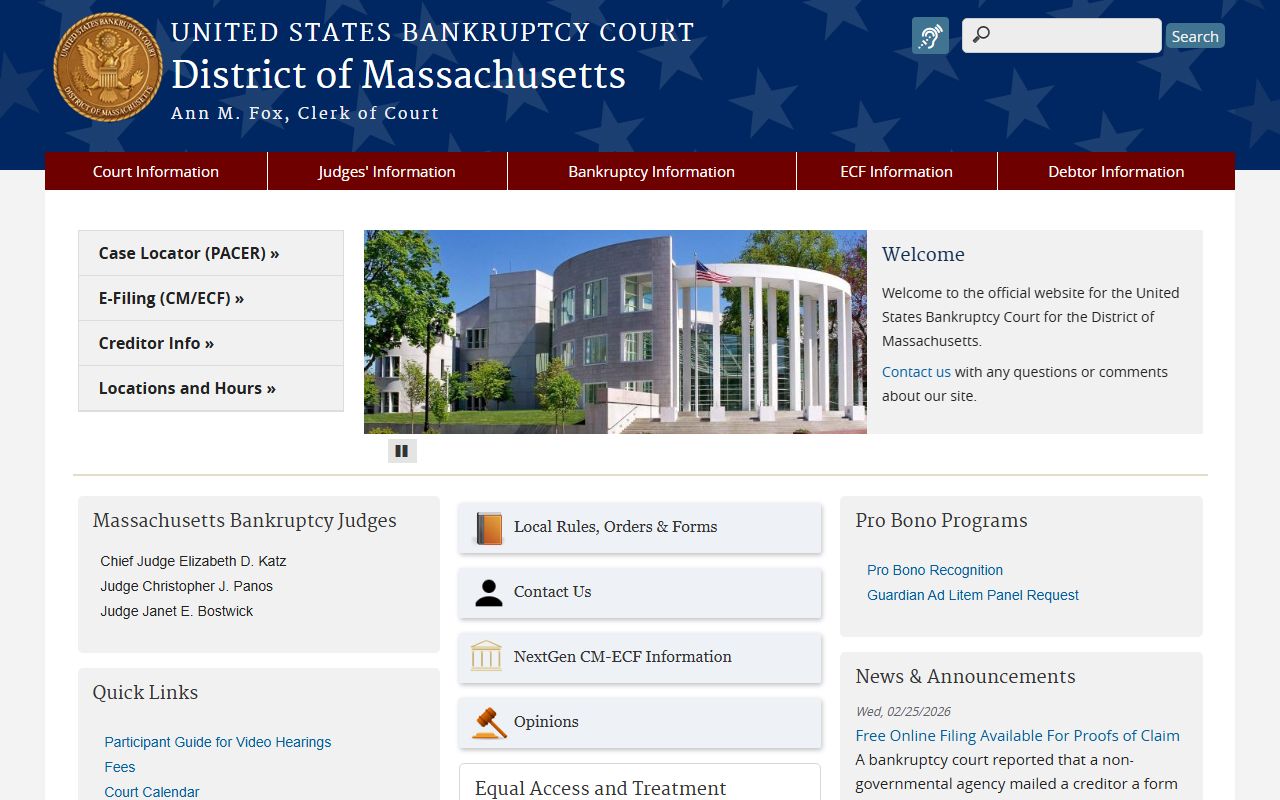
The court website lists filing instructions, local rules, forms, and fee schedules for all Eastern Division filers, including those in New Bedford.
How to Search New Bedford Bankruptcy Records
Bankruptcy records in New Bedford are federal public records. Most are accessible online. You have two main options: PACER and VCIS. PACER is the standard electronic access system. VCIS is a free phone line. Both give you case information filed in the Eastern Division.
PACER stands for Public Access to Court Electronic Records. You register at pacer.uscourts.gov. Once you have an account, you can search by debtor name, case number, Social Security number (last four digits), or tax ID. PACER charges $0.10 per page, but the fee is capped at $3.00 per document. If you run up less than $30 in charges per quarter, the court waives the fee entirely. Most simple searches cost very little. PACER gives access to full dockets, filed documents, and case status for any New Bedford bankruptcy case in the Eastern Division.
VCIS is a free automated phone service. Call 1-866-222-8029, press 1 for Massachusetts. You can get basic case status, hearing dates, and trustee info without creating an account. It runs 24 hours a day, seven days a week. If you just need to check whether a case is open or closed, VCIS is the quickest option for New Bedford residents.
To search, you need the debtor's full name (as it appears on the petition) or the case number. Searching by name can return multiple results if the name is common, so a case number is faster when you have it. Case numbers follow the format YY-NNNNN, such as 24-10001.
Filing for Bankruptcy in New Bedford
New Bedford residents file under one of three main chapters: Chapter 7, Chapter 13, or Chapter 11. Chapter 7 is a liquidation. It wipes out most unsecured debts, like credit cards and medical bills. Chapter 13 is a repayment plan over three to five years. Chapter 11 is usually for businesses but is open to individuals with high debt loads.
Filing fees are set by federal law and apply the same way in New Bedford as anywhere in Massachusetts. Chapter 7 costs $338. Chapter 13 costs $313. Chapter 11 costs $1,738. You pay these fees to the court when you file. If you cannot afford the Chapter 7 fee, you can ask to pay in installments or apply for a fee waiver. The court has forms for both requests. Chapter 13 filers generally cannot get a fee waiver, but installment payment plans are allowed.
Massachusetts has its own exemption laws that work alongside federal bankruptcy exemptions. One important protection is the homestead exemption. If you file a Declaration of Homestead before filing bankruptcy, you protect up to $500,000 in home equity. Without the declaration, the automatic protection is only $125,000. For New Bedford homeowners, filing a homestead declaration with the Bristol County Registry of Deeds before filing bankruptcy can make a real difference in what you keep.
When you file, a legal protection called the automatic stay takes effect immediately under 11 U.S.C. § 362. This stops most collection actions. Creditors cannot continue lawsuits, garnish wages, or contact you directly once the stay is in place. The stay gives you breathing room to work through the process. It does not stop certain actions, like criminal proceedings or child support enforcement, but it covers most common collection activity.
Exemptions are governed by 11 U.S.C. § 522. This section lists the property you can keep through bankruptcy. Massachusetts lets debtors use either the federal exemption list or the state list, but not both at the same time. Your attorney or a legal aid counselor can help you figure out which set protects more of your property based on what you own.
Chapter 7 Bankruptcy for New Bedford Residents
Chapter 7 is the most common type filed in New Bedford. You qualify by passing the means test, which compares your income to the median income for a Massachusetts household of your size. If your income is below the median, you pass automatically. If it is above, you do the full means test calculation to see if you still qualify. The current Massachusetts median income figures are posted on the U.S. Trustee Program website.
Once you file, a trustee is appointed to review your case. The trustee holds a short meeting called the 341 meeting, or meeting of creditors. You attend in person or by phone. Most 341 meetings last five to fifteen minutes. The trustee asks you questions under oath about your income, assets, and the papers you filed. Creditors can attend and ask questions too, but in most New Bedford Chapter 7 cases, few or no creditors show up.
If you pass the means test and the trustee finds nothing to liquidate, you get a discharge in about 60 to 90 days. The discharge eliminates most unsecured debt under 11 U.S.C. § 523. Some debts cannot be discharged, like recent tax debts, student loans in most cases, child support, and debts from fraud. The discharge order becomes part of your public bankruptcy record in New Bedford and is accessible through PACER.
New Bedford has a poverty rate of around 20 percent, and fishing industry income can be irregular. Chapter 7 is often a realistic path for residents whose income falls below the state median. A legal aid counselor can help you figure out if Chapter 7 fits your situation before you file.
Legal Aid and Bankruptcy Help in New Bedford
New Bedford has several local resources for residents who need help with bankruptcy. Some offer free services based on income. Others provide low-cost consultations. You do not have to navigate the process alone.
South Coastal Counties Legal Services has an office in New Bedford at 21 South Sixth Street, New Bedford, MA 02740. Phone: (774) 202-4820 or toll-free 1-800-244-9023. Intake hours are Monday through Thursday, 9 a.m. to 2 p.m. Staff speak English, Portuguese, and Spanish. South Coastal serves low-income residents throughout Bristol County and is one of the best first calls for New Bedford residents who think they may need bankruptcy help. They can advise on whether bankruptcy is the right option and help with the paperwork if you qualify for their services.
Justice Bridge Legal Center is located at 257-259 Union Street, New Bedford, MA 02740, phone (508) 449-9296. They offer legal services to the community and may be able to assist with bankruptcy-related questions or referrals.
For residents who can afford a consultation, Bucacci & Simonian is a bankruptcy law firm serving the New Bedford area. Their phone for New Bedford inquiries is (508) 993-6700. Their website at massbklaw.com explains their services and has background on the bankruptcy process in Massachusetts.
The state also maintains a general resource page for bankruptcy information at mass.gov. This page links to court forms, exemption guides, and official explanations of how bankruptcy works in Massachusetts. It is a good starting point before you contact an attorney or legal aid office.
The image below is from the Massachusetts debtor resources page, which New Bedford residents can use to find official guidance on filing and exemptions.
Screenshot from mass.gov showing state bankruptcy resources for Massachusetts debtors:
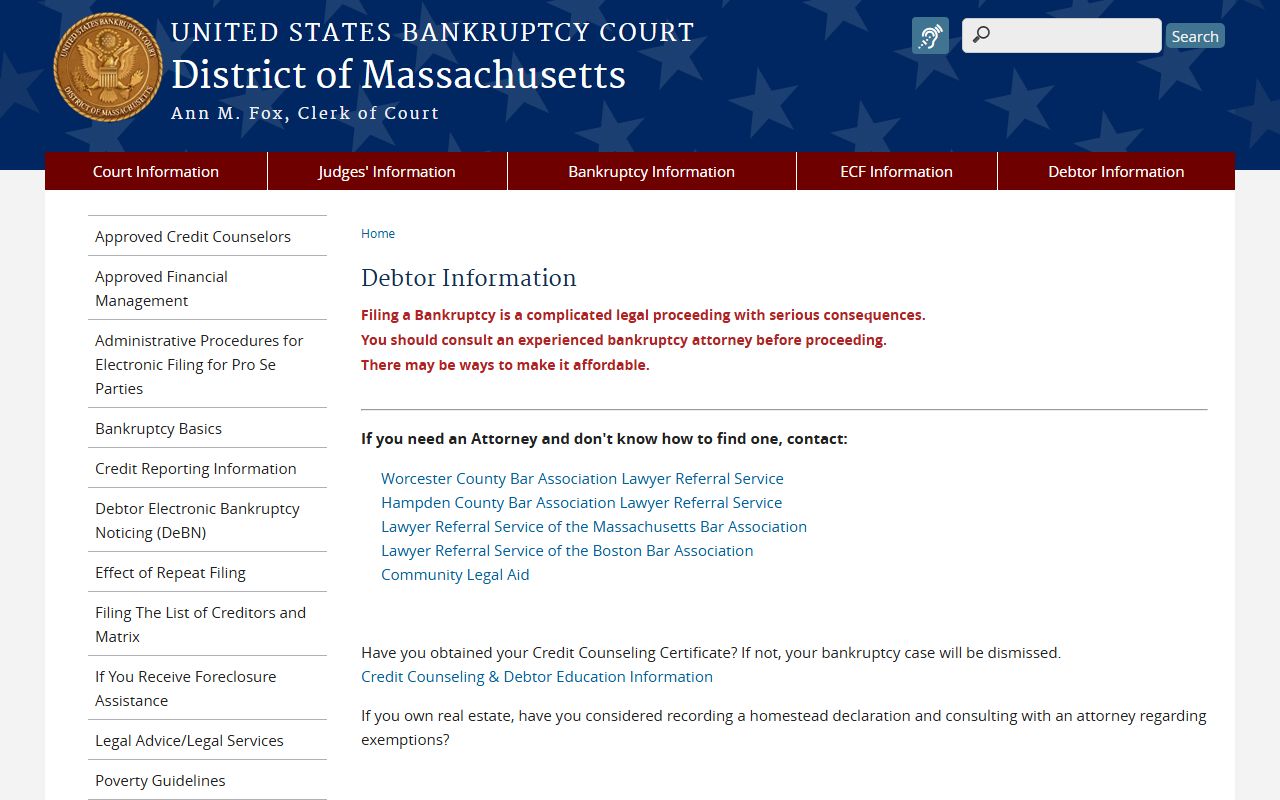
This state resource page is maintained by the Massachusetts government and covers both federal and state law aspects of bankruptcy for residents including those in New Bedford.
What Is in a New Bedford Bankruptcy Record
A bankruptcy case file contains a lot of information. The petition itself lists the debtor's name, address, Social Security number (partially redacted in public records), and a summary of debts and assets. The schedules attached to the petition break down income, expenses, property, creditors, and claimed exemptions. The statement of financial affairs covers recent financial transactions, business interests, and other disclosures.
All of these documents become part of the public record unless the court orders them sealed. Most bankruptcy records for New Bedford residents are publicly available through PACER. Social Security numbers are redacted from the public-facing version of documents, but other personal financial details remain visible. Employers, creditors, and anyone else can search PACER and see that a bankruptcy was filed, even after the case closes.
The discharge order, if granted, is also part of the record. It lists the date of discharge and confirms which debts were eliminated. If the court denies a discharge or the case is dismissed, that information appears in the docket as well. Case dockets for New Bedford filers in the Eastern Division are organized by year and case number and are fully searchable through PACER.
Court records related to bankruptcy also appear on credit reports. A Chapter 7 stays on a credit report for ten years. A Chapter 13 stays for seven years. These are separate from the court records accessible through PACER. If you are researching someone's financial background, both sources may be relevant depending on what you need.
Nearby Cities and Bristol County
New Bedford is in Bristol County. Other qualifying cities near New Bedford include:
- Fall River - Also in Bristol County, Eastern Division
- Taunton - Bristol County seat, Eastern Division
- Brockton - Plymouth County, Eastern Division
All Bristol County cities file in the Eastern Division in Boston. For full details on how Bristol County courts handle bankruptcy filings, including courthouse information and county-level resources, visit the Bristol County page.